

On a prior authorization status call, don't ask for "an update." Ask four things in order: the date the payer received the request, the current stage, whether anything is missing, and the date a decision is due. Compare that due date with the plan's decision clock. Since January 1, 2026, Medicare Advantage, Medicaid, and CHIP standard non-drug requests are due in 7 calendar days and expedited requests in 72 hours under CMS-0057-F. If the due date has passed, ask for a supervisor or the clinical review team. Get a reference number, the rep's name and ID, and the next action date at every step.
Why Chasing a Pending Prior Authorization Needs Its Own Script
A status call has a different job from a submission call. It has to turn "it's still pending" into a dated commitment, or show that the payer has missed its own deadline. The prior authorization phone call script covers getting a request on file with a reference number. This script covers the calls after that, when the procedure date is getting close and the portal still says pending.
Those follow-up calls add up. In the AMA's 2024 prior authorization physician survey (1,000 physicians, fielded late 2024), practices reported an average of 39 prior authorization requests per physician per week and 13 hours of physician and staff time to complete them. 40% of physicians said they have staff who work only on prior authorizations. Without a script, a status call can use up hold time and still end with nothing you can act on.
Know the Decision Clock Before You Dial
The CMS-0057-F decision clocks below cover non-drug items and services. Drug prior authorizations follow separate rules; confirm the applicable drug benefit and plan deadline before using this script.
Look up the plan's decision deadline before the call. Without it, you can't tell "pending" from "late." The deadline depends on the plan type, not on the payer's brand name, so check which line of business the member is in first.
| Plan type | Standard request | Expedited / urgent request | Source |
|---|---|---|---|
| Medicare Advantage (non-drug items and services) | 7 calendar days (from Jan 1, 2026); may be extended up to 14 calendar days only in listed circumstances, with written notice | 72 hours | CMS-0057-F; 42 CFR 422.568(b) |
| Medicaid and CHIP (fee-for-service and managed care; non-drug items and services) | 7 calendar days (from Jan 1, 2026) | 72 hours | CMS-0057-F |
| Employer group health plan (ERISA) | 15 days after receipt; one extension of up to 15 days with notice before the first period ends | 72 hours | 29 CFR 2560.503-1(f)(2) |
| Marketplace QHP on the federal exchange | Not covered by the CMS-0057-F decision clocks; check the plan contract and state law | Check plan and state law | CMS-0057-F fact sheet |
Two details decide most status disputes:
- The clock usually starts when the payer receives the request. That is why the received date is the first thing you ask for. The ERISA claims rule counts pre-service decisions from receipt (29 CFR 2560.503-1(f)(2)(iii)(A)), and the Medicare Advantage rule counts from receipt of the request (42 CFR 422.568).
- A request for more information can pause the clock. Under ERISA, when a plan extends the deadline because information is missing, the clock stops when the plan sends the notice and restarts when you respond (29 CFR 2560.503-1(f)(4)). If the rep says something is missing, ask when that notice was sent and where it went.
State law, the provider contract, and the payer's own policy can set shorter deadlines. Treat the table as the federal minimum, not the only rule.
Before You Dial: The Status Call Checklist
Have these ready before you call:
- Your original submission record — the portal confirmation, fax confirmation, or 278 acknowledgment, with the date and time
- The case or tracking number from the original request, plus the reference number from any earlier call
- Member ID, CPT/HCPCS codes, ICD-10 codes, ordering NPI, and servicing NPI/TIN, exactly as they were submitted
- The scheduled date of service — this decides whether to ask for an expedited review
- The decision clock that applies to this plan type (from the table above), and the date it runs out
- A direct callback number and fax number so a request for more information does not go to a shared inbox
Common Mistake
Calling without the submission timestamp. If the rep says the request arrived three days later than you sent it, or that there's no record of it, the call becomes an argument about dates. Without your confirmation in hand, the payer's date stands.
The Status Check Call Script
The script takes four questions and a close. Ask them in this order, because each answer tells you what to ask next.
Step 1: Confirm you've reached prior authorization, not claims
Many payer phone trees send prior authorization, claims, and eligibility to different queues. If you get transferred partway through, you usually start the hold over.
"Hi, this is [name] from [practice name], NPI [number]. I'm calling about
the status of a pending prior authorization request. Am I in the
utilization management or prior authorization department? If not, can
you transfer me directly and give me that department's number?"
Skip the blank template. Start with a review-ready draft.
Use the template as guidance, or let Muni prepare a payer-specific draft for your team to verify, sign, and submit.
First 3 appeals free, then $20 per appeal. Start with your denial letter or EOB and available records. No meeting or clearinghouse connection required.
Step 2: Identify the request and get the received date
"The case number is [number], for member [name], ID [number], CPT
[codes], submitted on [date] by [portal / fax / 278]. Can you confirm
the date and time your system shows the request as received?"
If that date doesn't match your submission record, say so on this call and read your confirmation to the rep: "Our fax confirmation shows it was delivered on [date] at [time]. Can you note that discrepancy on the case?"
Step 3: Ask for the stage and what's missing
"Pending" can mean several different things. Ask which one applies.
"What stage is this request in right now — intake, waiting on
clinical review, with a medical director, or waiting on information
from us? If you need anything from us, what exactly is it, and when
and where was that request sent?"
If the payer needs records, ask for the specific item by name, such as "the last two office notes showing six weeks of conservative therapy." "Clinicals" is too vague to act on. Ask for the fax number or upload path, and ask whether the case will be updated when the records arrive.
Step 4: Get the decision due date
This question matters most. Don't accept "five to seven business days" as an answer. Ask for a date.
"Based on the received date, what is the date a decision is due on
this request? Is it being handled as standard or expedited? Has an
extension been taken, and if so, when was the extension notice sent
and what's the reason?"
If the procedure date is close and waiting could seriously jeopardize the patient's life, health, or ability to regain maximum function, the treating clinician can ask for expedited handling:
"The service is scheduled for [date]. Dr. [name] has determined that
waiting for a standard decision could seriously jeopardize the
patient's health. We're requesting that this be reviewed as expedited.
What do you need from the physician to process that today?"
Only request expedited review when it is clinically justified and the treating clinician can document why. Never ask for it just to get to the front of the line.
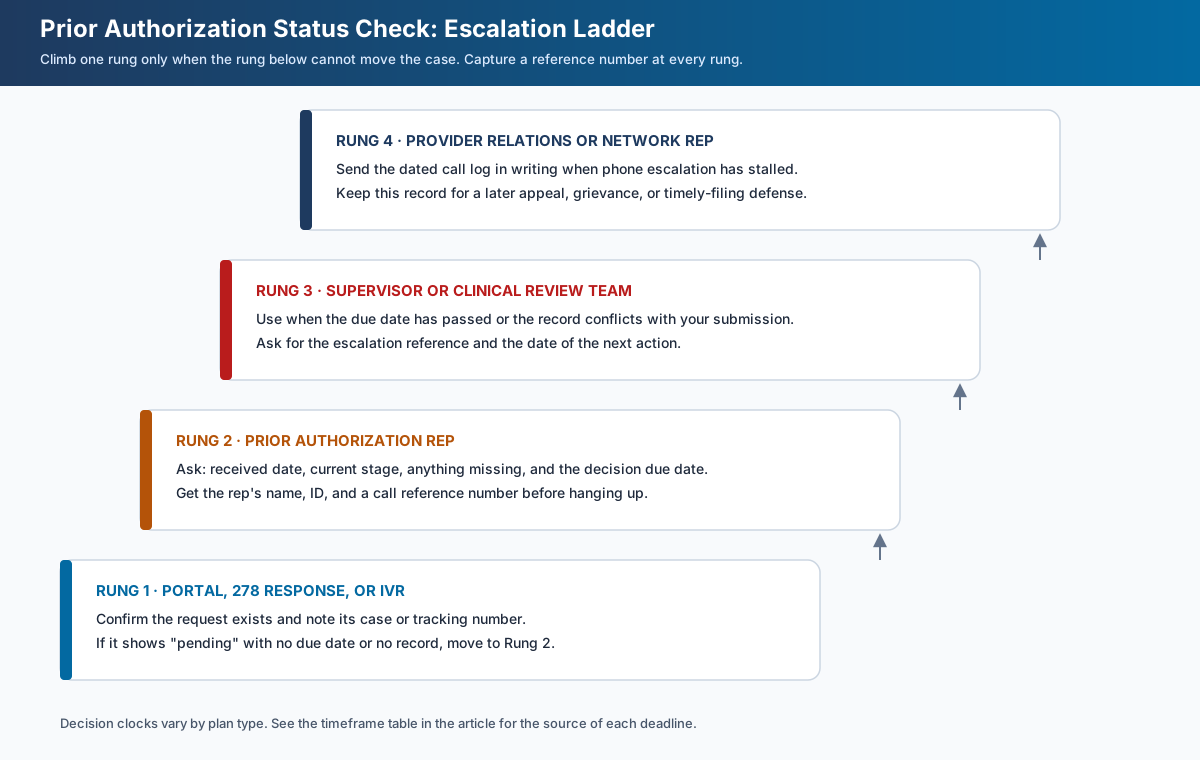
The Escalation Ladder: When "Pending" Is Past Due
Move up only when the step you're on can't move the case. Get a new reference number at every step, because each one is evidence.
| Rung | When to use it | What to ask for | What to log |
|---|---|---|---|
| 1. Portal, 278 response, or IVR | Every check, before calling | Case status and tracking number | Screenshot or status response with timestamp |
| 2. Prior authorization rep | Status unclear, no due date shown, or no record | Received date, stage, missing items, decision due date | Rep name, ID, call reference number |
| 3. Supervisor or clinical review team | Due date has passed, or payer's record conflicts with your submission | Escalation of the case and the date of the next action | Supervisor name, escalation reference, promised date |
| 4. Provider relations / network rep | Phone escalation has stalled or a pattern repeats across cases | Written follow-up on the specific case numbers | Email or letter with the dated call log attached |
"Your system shows this request received on [date], and the decision
was due on [date]. That date has passed and we don't have a decision.
I'd like to speak with a supervisor or someone on the clinical review
team who can escalate this case. Can you give me a reference number for
this escalation request before you transfer me?"Subject: Past-due prior authorization — case [number], member ID [number]
Hello [provider relations rep],
We submitted a prior authorization request for member [ID], CPT [codes],
on [date] via [portal / fax / 278]. Your system shows it received on
[date]. The decision was due on [date] under [applicable timeframe].
Status calls:
- [date], rep [name/ID], ref [number]: told [status / due date]
- [date], supervisor [name], ref [number]: escalation promised by [date]
The service is scheduled for [date]. Please confirm the current status,
the reviewer assigned, and the date we will receive a determination.
[Name], [title]
[Practice name] · NPI [number] · [direct phone] · [fax]When a Medicare Advantage Plan Misses the Clock
For Medicare Advantage, a plan that does not give timely notice of an organization determination has, by that failure, made an adverse determination that can be appealed under 42 CFR 422.568. If the plan is past due and escalation has stalled, ask the treating clinician whether to treat the request as denied and start the reconsideration process. Your dated call log is the proof the deadline passed.
Close Every Call the Same Way
Whatever happened on the call, end it the same way. The close is what makes the call usable as evidence later.
Stop sitting on hold with insurers.
Muni Calls handles prior authorizations, claim follow-ups, and eligibility checks — your staff gets 15+ hours back every week.
"Before we finish, can I get a reference number for this call, your
name and rep ID? Let me read back what we covered: received [date],
currently [stage], [nothing missing / missing item], decision due
[date]. Is that correct?"
Documenting the Status Call
A useful status call log records:
- Date, time, and length of the call, and who placed it
- The rep's name, rep ID, and call reference number, written exactly as the rep gave them
- The received date on the payer's system, and any difference from your submission record
- The stage and any missing items, in the rep's words
- The decision due date and whether the request is standard or expedited
- The next action and who owns it — records sent, callback date, or escalation date
Keep this log with the case, not in a personal notebook. If the request is later denied, or if the service is performed and the claim comes back as "no authorization on file," these dated notes help support an appeal. The prior authorization denial guide and what happens if a prior authorization is denied cover the next steps.
How Muni Calls Handles Prior Authorization Status Checks
For an approved prior authorization workflow, Muni Calls can place the outbound status call, follow the validated phone path, ask the status questions in order, and return the received date, stage, missing items, due date, and reference number as structured fields for staff review. Escalation decisions and clinical decisions, such as requesting expedited review, stay with your staff and clinicians. Payer, plan, state, and exception handling are confirmed during onboarding. They are not assumed to work the same across every payer line. The $499/month plan covers standardized receptionist use. Managed payer operations at higher volume get a fixed monthly quote based on call volume and workflow complexity.
For the calls around this one, see our scripts for eligibility verification, peer-to-peer review, and claim status. Payer-specific phone paths are in the UHC provider services phone guide and the Cigna prior authorization phone numbers guide. To compare phone automation options, see our guide to AI phone systems for medical clinics.
Frequently Asked Questions
What should I ask when calling to check a prior authorization status?
Ask for the date the payer received the request, the current stage of review, whether anything is missing, and the exact date a decision is due. Then close by getting a call reference number and the rep's name and ID.
How long can a payer take to decide a prior authorization?
It depends on the plan type. Since January 1, 2026, Medicare Advantage, Medicaid, and CHIP plans must decide standard non-drug requests within 7 calendar days and expedited requests within 72 hours under CMS-0057-F. Employer group health plans under ERISA have 15 days for pre-service requests, with one 15-day extension allowed, and 72 hours for urgent requests. State law or the provider contract can set shorter deadlines.
When does the prior authorization decision clock start?
Usually when the payer receives the request, not when you sent it. Ask for the received date on every status call and compare it with your portal, fax, or 278 confirmation.
What does it mean when a prior authorization is "pending additional information"?
The payer says it needs something before it can decide, usually clinical records. Ask exactly which document is needed, when and where the request was sent, and how to submit the response. For ERISA plans, the decision clock is paused from when the plan sends the notice until you respond, so send the information quickly.
What can I do if a payer is past its prior authorization deadline?
Ask for a supervisor or the clinical review team, cite the received date and the missed due date, and get an escalation reference number. If that stalls, send the dated call log to your provider relations representative. For Medicare Advantage, a plan's failure to give timely notice is itself an appealable adverse determination.
Can I ask for an expedited review on a status call?
Yes, if the treating clinician determines that waiting for a standard decision could seriously jeopardize the patient's life, health, or ability to regain maximum function. Ask what the payer needs from the physician to support the request, and only make it when the clinical need is real and documented.
Is a phone status update the same as an authorization?
No. A rep saying a request "looks approved" is not an authorization. Wait for the authorization number and the approval details (approved codes, units, dates, and servicing provider). Confirm they match what you're scheduling before the service is performed.
How often should we call to check a pending prior authorization?
Check the portal or electronic status first, and call when the status is unclear or the due date is close. Set the next call for the decision due date the rep gave you, not on a fixed weekly schedule. If the due date passes with no decision, escalate.
Stop Losing Days to "It's Still Pending"
A status call that ends without a received date, a due date, and a reference number gives you nothing to act on. Ask the same four questions each time, move up the escalation ladder only when the due date has passed, and log every rung. Then you'll know whether a request is on schedule or late, and you'll have the records to show it.
This guide reflects federal prior authorization decision timeframes in effect as of October 2026, including CMS-0057-F for Medicare Advantage, Medicaid, and CHIP, and the ERISA claims procedure regulation for employer group health plans. CMS-0057-F does not set decision clocks for drug prior authorizations. Timeframes, extension rules, and escalation contacts vary by payer, plan, state, and provider contract. Confirm the rules that apply to each request. This information is for administrative and billing purposes and is not legal or medical advice.