

Oncology claim denials fall into four main categories: prior authorization, step therapy, off-label use, and site-of-care. Each requires a different appeal strategy. For Cigna, oncology PA denials must go to EviCore—not Cigna's National Appeals Unit. For off-label agents, NCCN compendia listing is the strongest coverage evidence under state compendia laws and federal essential health benefit requirements. For step therapy, more than 40 states have exception laws with specific cancer protections.
Why Oncology Claims Face Elevated Denial Rates
Oncology billing sits at the intersection of the most denial-prone categories in healthcare reimbursement: high-cost agents requiring prior authorization, frequent off-label use, step therapy protocols targeting branded biologics, and payer site-of-care restrictions on infusion services.
According to the AMA's 2024 Prior Authorization Survey (n=1,004 physicians), 94% of physicians report that prior authorization requirements delay patient care. Oncologists face some of the most intensive PA burdens of any specialty. Cancer treatment protocols frequently involve combinations of FDA-approved drugs used in sequences, dosing schedules, and patient populations that differ from their original approval — making off-label denials a structural challenge rather than an edge case.
4 Distinct Denial Types, 4 Distinct Appeal Strategies
Oncology denials are not interchangeable. A prior authorization denial goes to the utilization reviewer — often EviCore for Cigna and Humana cases. A step therapy denial requires an exception request with clinical contraindication documentation. An off-label denial requires NCCN compendia evidence and a coverage law citation. A site-of-care denial challenges a location exclusion clause, not the drug's medical necessity. Using the wrong strategy for the denial type delays recovery and burns appeal windows.
Understanding which type of denial you are facing determines where to send the appeal, what documentation to compile, and how long you have to act.
The 4 Oncology Denial Types and How to Respond
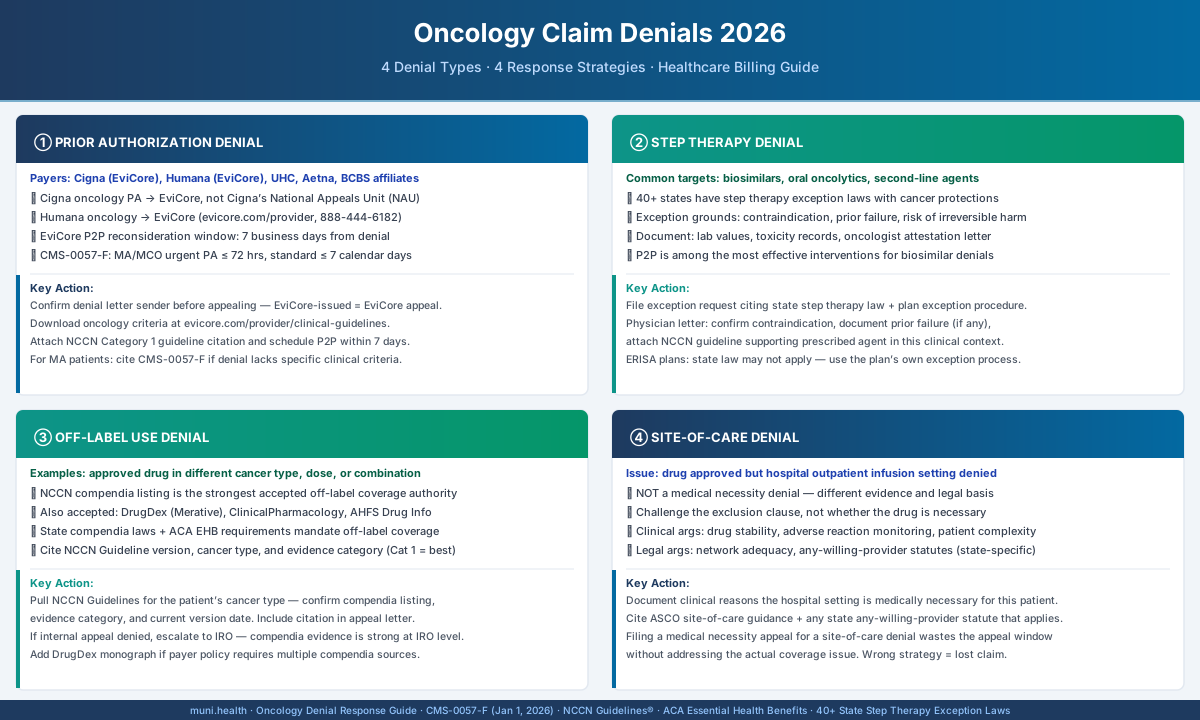
Oncology denials cluster into four categories with distinct characteristics and separate response tracks. Misidentifying the denial type is the most common reason appeals are submitted with the wrong documentation or to the wrong reviewer.
| Denial Type | Root Cause | Response Track | Primary Evidence |
|---|---|---|---|
| Prior Authorization | No PA on file or PA criteria not met | EviCore (Cigna/Humana) or plan appeal + P2P | NCCN Category 1 guidelines, clinical rationale |
| Step Therapy | Preferred agent not tried first | State exception request + P2P | Clinical contraindication, prior failure, toxicity records |
| Off-Label Use | Drug not FDA-approved for indication | Compendia coverage appeal + IRO if denied | NCCN Guidelines, DrugDex, ClinicalPharmacology |
| Site-of-Care | Hospital setting excluded by plan | Exclusion clause challenge | ASCO guidance, clinical complexity, network adequacy |
Prior Authorization Denials: EviCore Routing for Cigna and Humana
For Cigna plans, oncology prior authorization denials must go to EviCore — not Cigna's National Appeals Unit (NAU) in Chattanooga. Cigna delegates oncology PA review, along with imaging, cardiology, and MSK, to EviCore Healthcare. Providers who mail PA appeals to Cigna's general address lose time from the reconsideration window. The 7-business-day EviCore P2P window can close before the redirection is corrected. For cardiology-specific EviCore routing and cath-lab PA workflows, see the cardiology claim denials guide.
Humana similarly delegates oncology PA review to EviCore for commercial and Medicare Advantage plans. UHC, Aetna, and most BCBS affiliates handle oncology PA internally, each using proprietary clinical criteria: UHC applies its own internally developed guidelines, Aetna applies its Clinical Policy Bulletins (CPBs), and BCBS affiliates vary — some delegate imaging and MSK to AIM while handling oncology internally.
| Payer | Oncology PA Reviewer | P2P Contact | Reconsideration Window |
|---|---|---|---|
| Cigna (commercial & MA) | EviCore Healthcare | evicore.com/provider or 888-444-6182 | 7 business days from denial |
| Humana (commercial & MA) | EviCore Healthcare | evicore.com/provider or 888-444-6182 | 7 business days from denial |
| UHC (commercial) | UHC internally | UHC Provider Services portal | 180 days standard appeal |
| Aetna (commercial) | Aetna internally | Aetna Provider Portal P2P request | 180 days from denial |
| BCBS affiliates | Varies by affiliate (AIM, EviCore, or internal) | Check denial letter for reviewer identity | 30–180 days by affiliate |
For Medicare Advantage plans, CMS-0057-F (effective January 1, 2026) requires urgent PA decisions within 72 hours and standard PA decisions within 7 calendar days. The rule also mandates that denial notices include specific clinical criteria — a vague "not medically necessary" response no longer satisfies the requirement. If an oncology PA denial for a Medicare Advantage patient lacks specific criteria, cite CMS-0057-F in the appeal and request the clinical standard applied before the determination stands.
For a full walkthrough of how to structure PA appeals with clinical documentation, see our prior authorization denial complete guide.
Requesting a Peer-to-Peer Review for Oncology PA Denials
A peer-to-peer (P2P) review — where the treating oncologist speaks directly with the insurance medical reviewer — is among the most effective interventions for oncology PA denials. For EviCore, the P2P window is 7 business days from the initial denial, and the conversation must be scheduled proactively. EviCore does not schedule P2P by default.
When preparing for a P2P on an oncology PA case:
- Reference the specific NCCN Guideline version and recommendation category for the denied treatment
- Have the patient's treatment history, previous lines of therapy, and current laboratory values available
- Address the specific clinical criteria EviCore cited in the denial — their oncology clinical guidelines are published publicly at evicore.com/provider/clinical-guidelines
- For biosimilar or novel agent cases, prepare the mechanism-of-action distinction and any peer-reviewed outcome data supporting the prescribed agent over the preferred alternative
For a detailed guide on structuring P2P requests across payers, see our peer-to-peer review guide.
Don't Miss the EviCore 7-Business-Day P2P Window
For Cigna and Humana oncology denials managed by EviCore, the reconsideration and P2P window is 7 business days from the denial date. After that window closes, the only option is a formal 30-day appeal — which delays treatment and removes the most effective early intervention in the EviCore process.
Step Therapy Denials: Biosimilar and Alternative Agent Requirements
Step therapy denials occur when a payer requires a lower-cost or preferred agent before approving the prescribed oncology drug. For oncology, this most commonly affects biosimilar alternatives to branded biologics (trastuzumab, bevacizumab, rituximab, and their biosimilar versions), oral oncolytics with preferred-formulary alternatives, and second- or third-line agents prescribed before required first-line therapy documentation is in the record.
As of 2025, more than 40 states have enacted step therapy exception laws. Many include specific provisions for cancer patients, creating a statutory right to exception when:
- The required drug is contraindicated based on the patient's clinical history, comorbidities, or concomitant medications
- The patient has previously tried and failed the preferred drug
- The required drug is expected to cause adverse effects that would compromise the treatment course
- A treatment delay caused by the step therapy protocol would result in irreversible harm
For ERISA self-funded employer plans, state step therapy laws typically do not apply — but the plan's own exception procedures do, and those are enforceable under the plan documents. The ACA's internal and external appeals process applies to non-grandfathered marketplace plans, and external review organizations apply evidence-based medicine standards at the IRO level regardless of the employer plan's ERISA status.
Documenting a Step Therapy Exception for Oncology
An effective step therapy exception letter includes: (1) the specific clinical reason the required drug is contraindicated or inappropriate for this patient, (2) lab values, performance status scores, or comorbidity documentation supporting the clinical claim, (3) a treating oncologist's attestation, and (4) any NCCN guideline or peer-reviewed literature supporting the prescribed agent's clinical preference in the patient's specific situation.
For Aetna-specific step therapy policies and exception documentation, see our Aetna step therapy denial appeal guide.
Off-Label Oncology Denials: NCCN Compendia Evidence
Off-label use is structurally common in oncology. The FDA approves drugs for specific indications, but clinical practice routinely applies those agents to different cancer types, earlier or later lines of therapy, and combination regimens that were not part of the original registration trial. Insurers frequently deny these claims citing lack of FDA approval for the billed indication.
NCCN compendia listing is the strongest accepted evidence for coverage of an off-label oncology agent. Under state compendia coverage laws — enacted in the majority of states — and applicable federal essential health benefit requirements, non-grandfathered health plans must cover chemotherapy items recommended in major drug compendia. Recognized compendia include:
- NCCN Clinical Practice Guidelines in Oncology (NCCN Guidelines®) — the most frequently accepted authority across commercial payers and Medicaid
- DrugDex (Truven Health Analytics / Merative Micromedex) — accepted by most commercial payers and state Medicaid programs
- ClinicalPharmacology — accepted by a subset of commercial payers
- AHFS Drug Information — commonly required by Medicare for off-label coverage determinations
Medicare covers off-label oncology drug uses under CMS coverage policies referencing these compendia. Medicare Advantage plans must provide at least equivalent coverage to traditional Medicare FFS, making compendia listing equally relevant for MA patients.
When filing an off-label appeal:
- Pull the current NCCN Guideline for the specific cancer type — for example, NCCN Guidelines® Breast Cancer, Version 2.2026 — and identify the specific recommendation covering the denied drug and indication
- Note the evidence category: Category 1 is based on high-level evidence with uniform NCCN consensus; Category 2A is based on lower-level evidence with uniform NCCN consensus
- Include the DrugDex or ClinicalPharmacology monograph if the payer's coverage policy requires multiple compendia
- Cite the applicable state compendia coverage law or federal EHB requirement by name
- If the internal appeal is denied, request external review — compendia-based evidence has a strong track record at independent review organization (IRO) level
NCCN Category 1 Is the Strongest Evidence Standard
A NCCN Category 1 recommendation — based on high-level evidence with uniform NCCN consensus — is the clearest basis for overturning an off-label oncology denial. Even Category 2A (uniform consensus on lower-level evidence) has been widely accepted by commercial payers in both internal and external review. Include the guideline version, evidence category, and page reference in the appeal letter.
Site-of-Care Denials: Challenging Location-Based Restrictions
Site-of-care denials occur when a payer approves an oncology drug but denies the billed facility setting — typically denying a hospital outpatient infusion claim and redirecting the patient to an office-based infusion center or ambulatory infusion suite. This is not a medical necessity denial, and filing a medical necessity appeal is the wrong approach.
A site-of-care denial requires challenging the contractual exclusion clause or network adequacy using a different argument entirely:
- Drug preparation or stability requirements — some oncology agents require on-site pharmacy compounding, specialized temperature controls, or preparation timelines that an office infusion suite cannot provide
- Adverse reaction monitoring — complex infusion regimens with elevated hypersensitivity or anaphylaxis rates may require acute-care-capable monitoring not available in an independent office
- Patient complexity — comorbidities, compromised performance status, or concomitant supportive care requirements that create clinical risk during infusion
- Network adequacy — if no in-network infusion alternative exists within a reasonable travel distance, the site-of-care restriction may violate state network adequacy requirements
- Any-willing-provider statutes — several states require payers to accept any licensed provider for oncology infusion services
The American Society of Clinical Oncology (ASCO) has published guidance on appropriate oncology care site selection that establishes clinical standards for infusion setting decisions and can be cited in site-of-care appeals.
Site-of-Care Is a Contractual Appeal, Not a Clinical One
Filing a clinical medical necessity appeal for a site-of-care denial is a common and costly error. The payer is not questioning whether the drug is medically necessary — they are enforcing a location restriction. The appeal must address whether that restriction is clinically appropriate for this patient and whether comparable network alternatives actually exist.
Medicare Advantage Oncology: CMS-0057-F and Coverage Variance
Medicare Advantage plans must cover the same oncology drugs as traditional Medicare FFS — including off-label items supported by recognized compendia — but apply prior authorization to a substantially broader set of services. CMS-0057-F, effective January 1, 2026, constrains MA oncology PA administration in three specific ways:
- Faster decisions — urgent PA: 72 hours; standard PA: 7 calendar days
- Specific denial reasoning — vague "not medically necessary" responses do not satisfy the rule; plans must identify the specific clinical criteria applied
- Continuity of care — PA requirements may not be applied retroactively to disrupt an inpatient course of treatment already in progress
MA plans must also use current Medicare FFS coverage policy as the floor for oncology benefits. As CMS updates oncology Local Coverage Determinations (LCDs) and National Coverage Determinations (NCDs), MA plans must align. If an MA plan denies an oncology item covered under current FFS policy, the applicable LCD or NCD is a direct appeal basis independent of the plan's PA criteria.
For MA oncology appeals, always assess whether the denial implicates the plan's own PA criteria or is inconsistent with underlying FFS coverage policy — these are separate arguments that sometimes both apply to the same claim.
Oncology denials stacking up?
Muni Appeals uses the uploaded denial materials to surface the likely reviewing entity, P2P deadline risk, and relevant evidence checklist. Your billing team verifies the current route and deadline, then submits the review-ready packet.
First 3 appeals free, then $20 per appeal. Start with your denial letter or EOB and available records. No meeting or clearinghouse connection required.
How Muni Appeals Handles Oncology Denials
Oncology billing teams manage some of the most documentation-intensive appeals in healthcare. Each denial type requires a different evidence package, a different reviewer destination, and often a different statutory basis for coverage. A prior auth appeal to EviCore requires NCCN clinical guidelines and P2P scheduling. An off-label appeal requires compendia research and a coverage law citation. A step therapy exception requires a physician attestation and clinical history documentation. A site-of-care challenge requires contractual and network adequacy analysis.
Muni Appeals helps oncology billing teams:
- Suggest a likely denial type and appeal track from uploaded EOB codes for staff verification
- Provide likely EviCore versus plan-level routing guidance for staff to verify in Cigna and Humana cases
- Organize NCCN compendia documentation for off-label denials by drug and indication
- Surface peer-to-peer and appeal deadline risk from uploaded notices for staff verification and calendaring
- Compile step therapy exception letters with the clinical documentation required by state exception standards
For practices seeing recurring oncology denial patterns — the same agent denied repeatedly, or the same step therapy requirement blocking the same protocol — Muni surfaces the underlying pattern so the fix addresses the root cause rather than the individual claim.
Frequently Asked Questions
Does a Cigna oncology PA denial go to Cigna or EviCore?
It goes to EviCore. Cigna delegates oncology prior authorization to EviCore Healthcare, so the denial letter will come from EviCore and the appeal must be submitted to EviCore — not to Cigna's National Appeals Unit. The P2P reconsideration window is 7 business days from the denial date. Missing that window means going straight to a formal 30-day EviCore appeal with no P2P option. For a full guide to Cigna PA appeals, see how to appeal a Cigna prior authorization denial.
What is the strongest evidence for appealing an off-label oncology drug denial?
NCCN compendia listing is the strongest accepted evidence. Pull the current NCCN Guideline for the patient's cancer type and identify the recommendation covering the denied drug and indication — note the evidence category (Category 1 = strongest). Include the guideline version date and page reference in the appeal letter, along with the applicable state compendia coverage law or federal EHB citation. If the internal appeal is denied, escalate to an independent review organization — NCCN-supported off-label appeals have a strong track record at the IRO level.
Are step therapy protocols for biosimilars enforceable in oncology?
Step therapy applies in many oncology cases, but state exception laws create specific protections. As of 2025, more than 40 states have enacted step therapy exception statutes, and most include provisions for cancer patients when the required drug is contraindicated, has been previously failed, or when a delay would cause irreversible harm. Document the clinical basis for the exception and attach an oncologist attestation letter. For ERISA self-funded plans, state laws may not apply — use the plan's own exception process instead.
What makes a site-of-care denial different from a medical necessity denial?
A site-of-care denial approves the drug but denies the location of service — for example, refusing to pay for a hospital outpatient infusion when an office-based infusion is available. The payer is not questioning whether the drug is medically necessary, so a medical necessity appeal will not address the actual issue. The correct approach is challenging the site-of-care exclusion using clinical arguments (drug stability, adverse reaction monitoring, patient complexity) and legal arguments (network adequacy, any-willing-provider statutes).
Does CMS-0057-F apply to commercial oncology prior authorization?
No. CMS-0057-F applies to Medicare Advantage plans, Medicaid managed care organizations, and Qualified Health Plans. It does not apply to commercial employer group plans or traditional Medicare FFS. For commercial plans, check your state's prior authorization reform laws — many states have enacted parallel requirements. For MA and Medicaid MCO cases, cite CMS-0057-F in the appeal if the plan's PA decision exceeded the required timeline or if the denial notice lacked specific clinical criteria.
How do I find the clinical criteria EviCore used to deny an oncology PA?
EviCore publishes its clinical criteria publicly at evicore.com/provider/clinical-guidelines. Find the guideline for the denied specialty and procedure type. The denial letter will typically reference the specific criteria EviCore applied. Pull the published guideline and review each criterion. Structure your appeal letter and P2P preparation around each criterion directly — this targeted approach is substantially more effective than a general clinical narrative that doesn't address the stated basis for denial.
When does an oncology denial justify an independent review organization appeal?
If the internal plan appeal for an oncology denial is upheld — whether for medical necessity, off-label use, or step therapy — you have the right to request IRO review under applicable state law and ACA requirements for non-grandfathered commercial plans. IRO reviewers apply evidence-based medicine standards independent of the payer, making this the appropriate escalation for cases where compendia evidence or clinical guidelines clearly support the treatment. See our independent review organization guide for submission requirements and timelines.
Ready to Recover Your Oncology Denials?
Oncology claim denials are recoverable — but only when the appeal targets the right reviewer, uses the right evidence, and reaches the right destination before the window closes. Knowing that Cigna oncology PA goes to EviCore, that NCCN compendia listing is the governing evidence standard for off-label appeals, and that step therapy exceptions are legally available in most states positions your billing team to fight these denials systematically rather than claim by claim.
Get Started:
- Identify denial type from EOB codes and map the correct appeal track
- Route EviCore vs. plan appeals correctly for Cigna and Humana oncology cases
- Compile NCCN compendia documentation for off-label denials by drug and indication
- Track P2P windows and appeal deadlines across all open oncology cases
This guide reflects 2026 oncology claim appeal procedures and regulations. EviCore delegation arrangements, step therapy exception laws, and CMS-0057-F applicability vary by plan type, state, and contract year. State step therapy laws change frequently — verify current requirements with your state insurance department. Consult qualified billing counsel for complex disputes.