

Cardiology claim denials fall into four categories: echocardiogram frequency edits, cardiac stress test medical necessity, cath-lab prior authorization, and cardiac device monitoring frequency limits. Each requires a different appeal strategy. Echo denials most often come from incomplete 93306 element documentation or a missing clinical-status-change justification for repeat studies. Stress test denials need documented symptoms and risk factors. Cath-lab PA routes through EviCore for Cigna cases. Device monitoring denials typically trace to a 30- or 90-day frequency window violation.
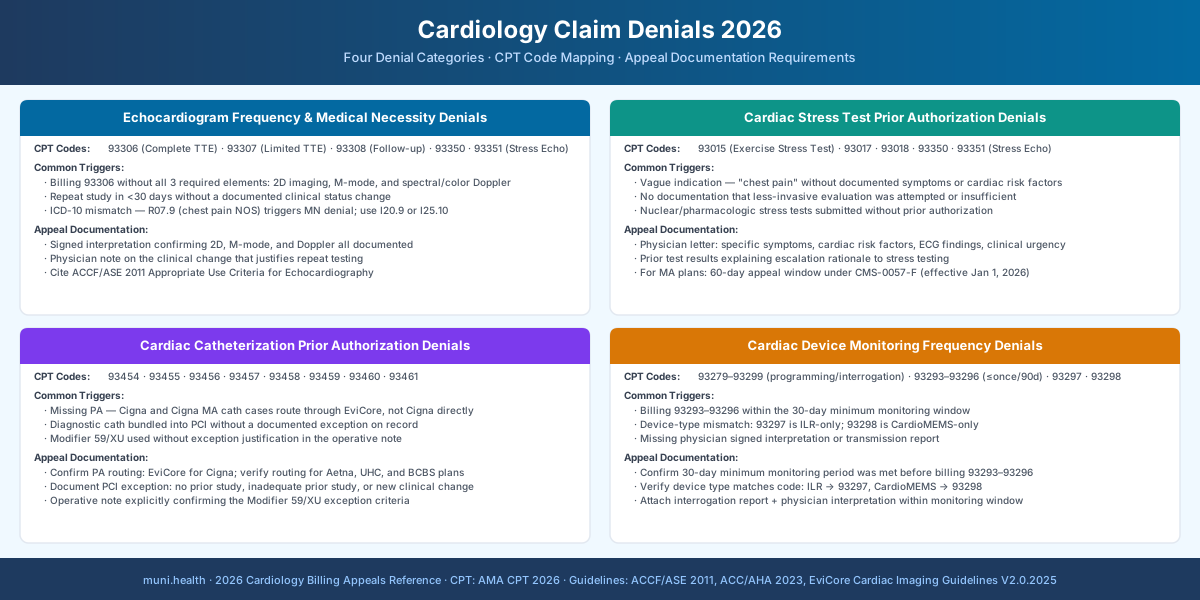
Why Cardiology Claims Face Elevated Denial Rates
Cardiology billing sits at the intersection of three high-scrutiny categories: high-cost imaging, complex prior authorization workflows, and procedure bundling rules that vary by payer. A single documentation gap — a missing Doppler annotation, a vague ICD-10 code, or a prior authorization submitted to the wrong reviewing entity — can turn a clean claim into a multi-week recovery effort.
According to the AMA's 2024 Prior Authorization Survey (n=1,004 physicians), 94% of physicians report that prior authorization requirements delay patient access to care, and 31% say their PA requests are often or always denied. The AMA's 2025 survey, reported by the AHA in May 2026, confirmed the burden continues to grow. Cardiology practices — which rely heavily on imaging, device procedures, and invasive diagnostics — face PA requirements on a substantial share of their billed services.
Two factors make the current environment harder than prior years:
EviCore's expanded cardiovascular role. EviCore by Evernorth manages prior authorization for cardiovascular procedures for Cigna (including Cigna Medicare Advantage effective January 1, 2026 under the HealthSpring rebrand) and select regional health plans. Submitting a cardiology PA to Cigna directly when EviCore holds the review contract is a common denial trigger that additional clinical documentation alone cannot fix — the routing error must be corrected first.
CMS-0057-F (effective January 1, 2026). Medicare Advantage plans must now issue standard PA decisions within 7 calendar days and expedited decisions within 72 hours, and must provide specific clinical reasons for any denial. This creates documented appeal grounds for cardiology PA denials that were previously returned with vague utilization language.
The 4 Most Common Cardiology Claim Denial Types
The four cardiology denial categories differ in cause, appeal strategy, and the specific documentation each requires. Misidentifying the denial type is the most common reason a cardiology appeal is submitted with the wrong evidence or routed to the wrong reviewer.
| Denial Type | Key CPT Codes | Primary Trigger | Appeal Documentation |
|---|---|---|---|
| Echo frequency / medical necessity | 93306, 93307, 93308, 93350, 93351 | Incomplete 93306 element documentation; repeat study within 30 days without clinical change | Signed report with 2D, M-mode, Doppler confirmed; clinical change note; correct ICD-10 |
| Stress test prior authorization | 93015, 93017, 93018, 93350, 93351 | Vague MN documentation; missing PA for nuclear or pharmacologic tests | Physician letter with specific symptoms, risk factors, ECG findings, escalation rationale |
| Cath-lab prior authorization | 93454–93461 | Missing PA; diagnostic cath bundled into PCI without documented exception | EviCore routing confirmed for Cigna; PCI exception documented; Modifier 59/XU operative note |
| Device monitoring frequency | 93279–93299, 93293–93296, 93297, 93298 | Billing within 30-day minimum window; device-type code mismatch | Interrogation report; physician interpretation; device type verified against billed code |
Echocardiogram Denials: 93306, 93307, 93308, and Stress Echo
Echocardiogram denials most often come from two separate problems: incomplete documentation for the billed CPT code, and repeat studies billed without a documented clinical change. Fixing the appeal requires knowing precisely what each code demands before the claim is submitted.
The 93306 documentation problem. CPT 93306 — a complete transthoracic echocardiogram with Doppler — requires three documented elements: 2D imaging, M-mode recording, and spectral/color flow Doppler. If any one of the three elements is absent from the interpretation report, most payers will deny the code in full. The correct fallback is CPT 93307 (limited TTE) or 93308 (follow-up/limited), which do not require all three components. Billing 93306 when the report documents only two of the three elements is both a denial trigger and a compliance risk under applicable Local Coverage Determinations (LCDs).
Frequency edit denials. Medicare and most commercial payers restrict repeat echocardiography for established cardiac diagnoses — typically once per year — unless a change in clinical status is documented. A repeat study within 30 days of a prior echo will be denied unless the ordering physician's note explicitly records the clinical change: new symptoms, hemodynamic instability, a cardiac event, or a post-procedural indication. General statements ("follow-up") do not satisfy the clinical change requirement.
ICD-10 mismatch. Billing 93306 with R07.9 (chest pain, unspecified) frequently triggers a medical necessity denial. The same study billed with I20.9 (angina pectoris) or I25.10 (atherosclerotic heart disease of native coronary artery without angina) is far more likely to pass medical necessity review because the diagnosis directly supports the clinical indication for imaging.
Appeal Deadline for Echo Denials
Commercial echo appeal deadlines vary by payer. Most allow 180 days from the denial date for a first-level appeal, but some plans impose a 60-day window. Always verify the deadline in the denial letter — the contract and plan-level appeal rules can differ — because missing the deadline typically forfeits external review rights.
What a successful echo appeal includes:
Appeal — Echocardiogram Medical Necessity Denial
Patient: [Name] | DOS: [Date] | CPT: [93306/93307/93308]

Denial reason: [medical necessity / frequency limitation / documentation incomplete]

Clinical indication:
Diagnosis (ICD-10): [code] — [full description]
Symptoms: [chest pain, dyspnea, palpitations — be specific, not "cardiac symptoms"]
Risk factors: [hypertension, CAD, prior MI, diabetes, family history]
[If repeat study within frequency window:]
  Clinical status change: [specific new event, finding, or hemodynamic change]

Documentation attached:
- Signed interpretation confirming 2D, M-mode, and Doppler all performed and documented
- Ordering physician notes confirming clinical indication
- [If repeat:] Records of interval event or clinical status change

Guideline reference:
ACCF/ASE/AHA 2011 Appropriate Use Criteria for Echocardiography
[If stress echo:] ACC/AHA 2023 Multimodality Appropriate Use Criteria — Chronic Coronary Disease
Skip the blank template. Start with a review-ready draft.
Use the template as guidance, or let Muni prepare a payer-specific draft for your team to verify, sign, and submit.
First 3 appeals free, then $20 per appeal. Start with your denial letter or EOB and available records. No meeting or clearinghouse connection required.
For stress echocardiograms (CPT 93350, 93351), the same ICD-10 accuracy and documentation rules apply, plus the prior authorization requirements covered in the next section.
Cardiac Stress Test Prior Authorization Denials
Cardiac stress test denials are almost always a medical necessity documentation problem — the payer is not disputing that the test was ordered, but that the submitted documentation meets their utilization criteria. Most commercial payers and Medicare Advantage plans require prior authorization for pharmacologic stress tests and nuclear myocardial perfusion imaging due to their cost and clinical specificity. Standard exercise treadmill tests (CPT 93015) typically do not require PA from most major commercial payers, but nuclear imaging add-ons (78451, 78452) almost always do.
What a "not medically necessary" denial for stress testing means. The documentation submitted with the PA request did not include: (1) specific symptoms — chest pain, dyspnea, palpitations, syncope, or near-syncope; (2) cardiac risk factors — hypertension, diabetes, prior myocardial infarction, family history of early CAD, or abnormal ECG findings; and (3) a rationale for why less-invasive evaluation was insufficient or had already been attempted. A request listing "chest pain, cardiac workup" without specifics will not pass most PA reviewers.
| Stress Test CPT | Procedure | PA Required (Common) | Medical Necessity Documentation |
|---|---|---|---|
| 93015 | Exercise stress test (tracing only) | Rarely | Symptoms + risk factors; standard ECG interpretation |
| 93017 | Exercise stress test (monitoring only) | Rarely | Same as 93015 |
| 93018 | Exercise stress test (physician supervision) | Rarely | Same as 93015 |
| 93350 | Stress echocardiogram | Frequently (payer-specific) | Symptoms, ECG findings, echo indication per ACC AUC |
| 93351 | Stress echo with physician supervision | Frequently | Same as 93350 plus supervision documentation |
| 78451–78452 | Nuclear myocardial perfusion (SPECT) | Almost always | Symptoms, risk stratification, failed or insufficient prior workup |
For Medicare Advantage patients, CMS-0057-F (effective January 1, 2026) requires the plan to issue a standard PA decision within 7 calendar days and cite the specific clinical criteria the request did not meet. That specific reason is the exact documentation gap to address in the appeal.
A peer-to-peer review — available before the formal appeal window in most cases — is often the fastest resolution for stress test denials where the clinical picture is complex but documentation was submitted incompletely. For EviCore-managed cases, the peer-to-peer window is 7 business days from the initial denial.
Cardiac Catheterization PA Denials: 93454–93461
Cardiac catheterization PA denials come from three sources: a missing authorization, a bundling dispute between a diagnostic cath and a PCI procedure, or incorrect modifier usage. Each requires a different response.
Prior authorization requirements. CPT codes 93454 through 93461 — covering diagnostic cardiac catheterization across left heart, right heart, and combined studies — require prior authorization from most major commercial payers and Medicare Advantage plans. For Cigna and Cigna Medicare Advantage, these requests are submitted through EviCore's cardiovascular program. Sending the PA request to Cigna directly is a routing error that starts the clock on the reconsideration window while the request sits in the wrong queue. See our Cigna EviCore appeal guide for portal access and case submission steps.
EviCore's Cardiac Imaging Guidelines (V2.0.2025, effective October 1, 2025; 2026 CPT Addendum effective January 1, 2026) govern the cardiovascular PA criteria. Appeals against EviCore denials are submitted through evicore.com/provider/request-an-appeal. The denial letter references the specific guideline criterion the case did not meet — address that criterion directly in the reconsideration.
The bundling dispute. When a diagnostic catheterization is performed at the same session as a percutaneous coronary intervention, payers bundle the diagnostic study into the PCI reimbursement. The diagnostic cath can be billed separately only when one of three exceptions applies: (1) no prior diagnostic study of adequate quality existed; (2) a prior study was inadequate to plan the PCI; or (3) a significant clinical change occurred since the prior study requiring new diagnostic assessment. Modifier 59 (or XU for distinct procedural service) must be applied, and the operative note must explicitly document the exception — not merely reference the code.
Submitting Modifier 59 or XU without that exception written into the operative note is one of the most common cath-lab appeal failures. The modifier alone is denied on audit even when the clinical basis for the exception exists in the chart.
Cardiac Device Monitoring Denials: 93279–93298
Device monitoring denials are almost always a frequency-edit or device-type matching problem, and both are correctable once the specific error is identified. CMS Billing Article A56602 governs cardiac rhythm device evaluation coding under Medicare.
Prepare this appeal packet with your team.
Draft the appeal, coordinate missing documents, and approve the reviewed packet. Keep your clearinghouse; your practice checks deadlines and submits through the payer’s accepted channel.
First 3 appeals free, then $20 per appeal. Start with your denial letter or EOB and available records. No meeting or clearinghouse connection required.
| CPT Code(s) | Device Type | Frequency Limit | Common Denial Cause |
|---|---|---|---|
| 93293–93296 | Pacemaker / ICD — remote + in-person interrogation | ≤ once per 90 days; ≥ 30-day monitoring window required | Billing before the 30-day minimum monitoring period closes |
| 93297 | Implantable loop recorder (ILR) — remote | Per monitoring period | Using for pacemaker or ICD — device-type mismatch with 93295/93296 |
| 93298 | CardioMEMS hemodynamic monitor — remote | Per monitoring period | Using for ILR or pacemaker — device-type mismatch |
| 93279–93284 | Pacemaker — programming evaluation (in-person) | Per clinical need | Missing documentation of iterative adjustment performed during session |
| 93285–93291 | ICD / ILR — programming or interrogation (in-person) | Per clinical need | Incomplete device identifier in the record |
The 30-day minimum for 93293–93296 is a hard cutoff: a monitoring period of less than 30 days results in denial regardless of clinical circumstances. The 90-day maximum means these codes cannot be billed more than once per quarter per device.
Device-type mismatches are the other common source of denials. CPT 93297 is specific to implantable loop recorders (ILRs such as the Medtronic Reveal LINQ or Abbott Confirm Rx). CPT 93298 is specific to the Abbott CardioMEMS implantable hemodynamic monitor. Using either code for a different device type — or billing 93295 for an ILR instead of 93297 — will be denied on payer claim review.
Commercial payers apply their own coverage rules independently of Medicare. Aetna, Cigna, and UnitedHealthcare each have separate coverage policies for cardiac device monitoring that must be verified at device implant; the frequency limits and coverage criteria differ from CMS guidance and from each other.
Appeal documentation for device monitoring denials:
- Device interrogation transmission report showing monitoring start and end dates
- Physician signed interpretation within the allowed monitoring period
- Device identifier confirming the device type matches the billed CPT code
- For frequency denials: confirmation that the 30-day minimum monitoring window was met before the claim was submitted
For urgent device monitoring situations requiring faster review, see the expedited appeal process guide — Medicare Advantage cases under CMS-0057-F allow a 72-hour turnaround for urgent requests.
How Muni Appeals Helps Cardiology Billing Teams
Cardiology denials are recoverable when the appeal matches the denial type. Submitting an echo frequency appeal when the actual problem is a 93306 element documentation gap — or routing a Cigna cath PA reconsideration to Cigna instead of EviCore — prolongs the denial lifecycle without addressing the root cause.
Muni Appeals organizes uploaded cardiology denial materials, matches documentation to the cited payer criteria, and surfaces likely EviCore versus direct-payer routing for staff verification. Staff must confirm the current guideline version, timeline, and submission channel before filing.
Frequently Asked Questions
Which cardiology CPT codes most commonly require prior authorization?
PA requirements vary by payer, but generally apply to nuclear myocardial perfusion imaging (78451, 78452), stress echocardiograms (93350, 93351), cardiac catheterization (93454–93461), pharmacologic and dobutamine stress tests, and most interventional cardiology procedures. Routine exercise treadmill tests (93015–93018) typically do not require PA from major commercial payers. Payer-specific rules should always be verified directly before scheduling, as requirements differ by plan type, state, and procedure category.
What documentation is required to appeal an echocardiogram medical necessity denial?
A complete echo appeal requires: (1) the signed interpretation report confirming all required elements for the billed code were performed and documented; (2) the ordering physician's clinical notes with the specific diagnosis, symptoms, and risk factors; (3) for a repeat study, an explicit description of the clinical status change justifying retesting; and (4) the correct ICD-10 code that supports the clinical indication. Appeals referencing the ACCF/ASE 2011 Appropriate Use Criteria for Echocardiography carry more weight with medical directors than appeals that rely solely on physician narrative.
How do I appeal a cardiac stress test PA denial when clinical notes were not submitted with the original request?
Attach the complete clinical notes to the appeal. Do not resubmit to the same adjudication queue without new documentation — the appeal must include the information that was missing from the original request. The appeal letter should describe specifically what clinical information was omitted, provide the physician's documentation including symptoms, cardiac risk factors, and ECG findings, and explain the medical rationale for stress testing over continued conservative management. If available, prior test results showing why a less-invasive evaluation was insufficient strengthen the appeal.
Does EviCore review all cardiology prior authorization requests?
No. EviCore reviews cardiovascular PA for the health plans that have contracted with it — which includes Cigna and Cigna Medicare Advantage (as of January 1, 2026), Network Health, and select regional plans. UnitedHealthcare, Aetna, BCBS affiliates, and Humana use their own internal utilization management for most cardiology cases, though this varies by plan type and procedure. Always confirm the specific PA submission route from the patient's denial letter or the plan's provider portal before requesting authorization or submitting a reconsideration. Note that radiology/imaging PA delegation runs on a separate track from cardiology — see our imaging prior authorization denial appeal guide for which entity (EviCore, Carelon, or RadMD) reviews CT, MRI, and PET by payer.
Can I request a peer-to-peer review after a cardiology PA denial?
Yes. Most payers and EviCore allow a peer-to-peer call between the ordering cardiologist and the reviewing medical director after an initial denial. For EviCore-managed cases, the peer-to-peer window is 7 business days from the denial date. This is typically available before the formal first-level appeal window closes and must be scheduled proactively — EviCore does not initiate the call. A peer-to-peer is especially effective for cardiac cath and complex imaging denials where the clinical rationale is strong but the documentation submitted with the original PA request was incomplete.
What is the appeal deadline for a cardiology claim denial?
Commercial first-level appeal deadlines vary: most major payers allow 180 days from the claim denial date, but some plans impose a 60-day window. Medicare Advantage plans under CMS-0057-F must accept appeals within 60 days of the denial for standard cases. Always use the deadline shown in the denial letter — the contract timeline and the plan-specific appeal rules can differ — because missing the deadline typically forfeits the right to external review.
When should I cite the ACC Appropriate Use Criteria in a cardiology appeal?
Cite the ACC AUC when the denial is based on a characterization of the procedure as "not medically necessary" or "not indicated." The ACC/AHA 2023 Multimodality Appropriate Use Criteria for the Detection and Risk Assessment of Chronic Coronary Disease and the ACCF/ASE 2011 Appropriate Use Criteria for Echocardiography are the primary references for echo and cardiac imaging appeals. EviCore's own Cardiac Imaging Guidelines reference both documents — a denial that conflicts with the AUC criteria those guidelines cite is an explicit basis for challenging the determination in the first-level appeal and requesting independent external review if the denial is upheld.
Does CMS-0057-F affect cardiology prior authorization for Medicare Advantage patients?
Yes. Effective January 1, 2026, CMS-0057-F requires Medicare Advantage plans to issue standard PA decisions within 7 calendar days, expedited decisions within 72 hours, and to provide specific clinical reasons for every denial. The specific clinical criterion cited in the denial is the exact documentation gap to address in the appeal. Denials that provide vague or generic clinical reasoning rather than the specific criterion the request failed to meet are grounds for escalation. CMS-0057-F does not apply to traditional Medicare fee-for-service or to commercial employer-sponsored plans outside the ACA marketplace.
This guide reflects 2026 cardiology billing and appeal procedures. CPT code requirements, payer prior authorization rules, and EviCore clinical guidelines are updated annually. State requirements, plan-level rules, and Medicare versus commercial payer policies vary. This information is for administrative and billing purposes and is not medical advice.