

If your health insurance denied a treatment your doctor ordered, you have the legal right to appeal — usually within 180 days of the denial letter. Start today: call your insurer and get the specific denial reason in writing, ask your doctor's office to send a letter of medical necessity, and file a written internal appeal before the deadline on your letter. If that appeal is denied too, you have the right to a free, independent external review that no insurer can block — and it can overturn the decision for good.
If This Feels Like an Emergency Right Now, Do This First
This guide is about appealing a denial — it assumes you have some time. If you're having chest pain, severe shortness of breath, a fainting spell, or any symptom that feels like it's getting worse by the hour, call 911 or go to the nearest emergency room now. Emergency care does not require prior authorization, and a denial letter cannot stop it — federal law requires insurers to cover emergency services regardless of authorization status. Appeal the paperwork after you're stable, not instead of getting seen.
You Have More Power Here Than It Feels Like Right Now
A denial letter can feel final. It isn't. It's the opening move in a process that federal law built specifically so you don't have to just accept "no."
Insurers denied about 19% of in-network claims for ACA marketplace plans in 2024 — tied with 2023 for the highest rate since the marketplaces opened in 2015 (KFF, "Claims Denials and Appeals in ACA Marketplace Plans in 2024"). Of those denials, fewer than 1% of patients appealed. When people did challenge a denial internally, insurers reversed their own decision in roughly a third of cases. Fewer than 1 in 20 of the internal appeals insurers upheld ever went on to external review — the free, independent step where an outside doctor gets the final say.
The system is not designed around the assumption that you'll fight back. Most people don't. That's exactly why appealing at all already puts you ahead of almost everyone who got the same letter you did.
Key Statistic
In 2024, insurers denied roughly 1 in 5 in-network marketplace claims, but fewer than 1% of patients appealed. When patients did appeal internally, insurers reversed themselves about a third of the time (KFF, 2024).
This guide walks through exactly what to do, in order, whether the denial is a prior authorization your doctor never got approved, or a claim denied after the fact. It includes a copy-paste appeal letter, the real deadlines by plan type, and a list of people who will help you for free.
What Kind of "No" Did You Get?
The type of denial on your letter determines your next move, so identify it before you do anything else.
- Prior authorization denial. Your insurer refused to approve a treatment, test, or medication before you received it. Nothing has happened yet — this is usually the fastest denial to fight, because your doctor can often get a same-day or same-week phone review with the insurer's medical director.
- Medical necessity denial. The insurer says the treatment wasn't medically necessary under their coverage policy, usually after reviewing your doctor's documentation. This turns on clinical evidence, which makes your doctor's involvement essential.
- Non-covered benefit or exclusion. Your plan document excludes the specific service. This is the hardest type to win outright, but a medical-exception request is sometimes still possible if no covered alternative exists.
- Out-of-network denial. The insurer won't cover the provider because they're outside your plan's network. Success usually depends on showing no adequate in-network option exists, or that the care was an emergency.
- Retrospective claim denial. The service already happened, and the insurer is refusing to pay after the fact — often for coding, timely-filing, or after a post-payment review. Your doctor's billing office needs to be looped in immediately, since parts of this may be their process to fix, not yours.
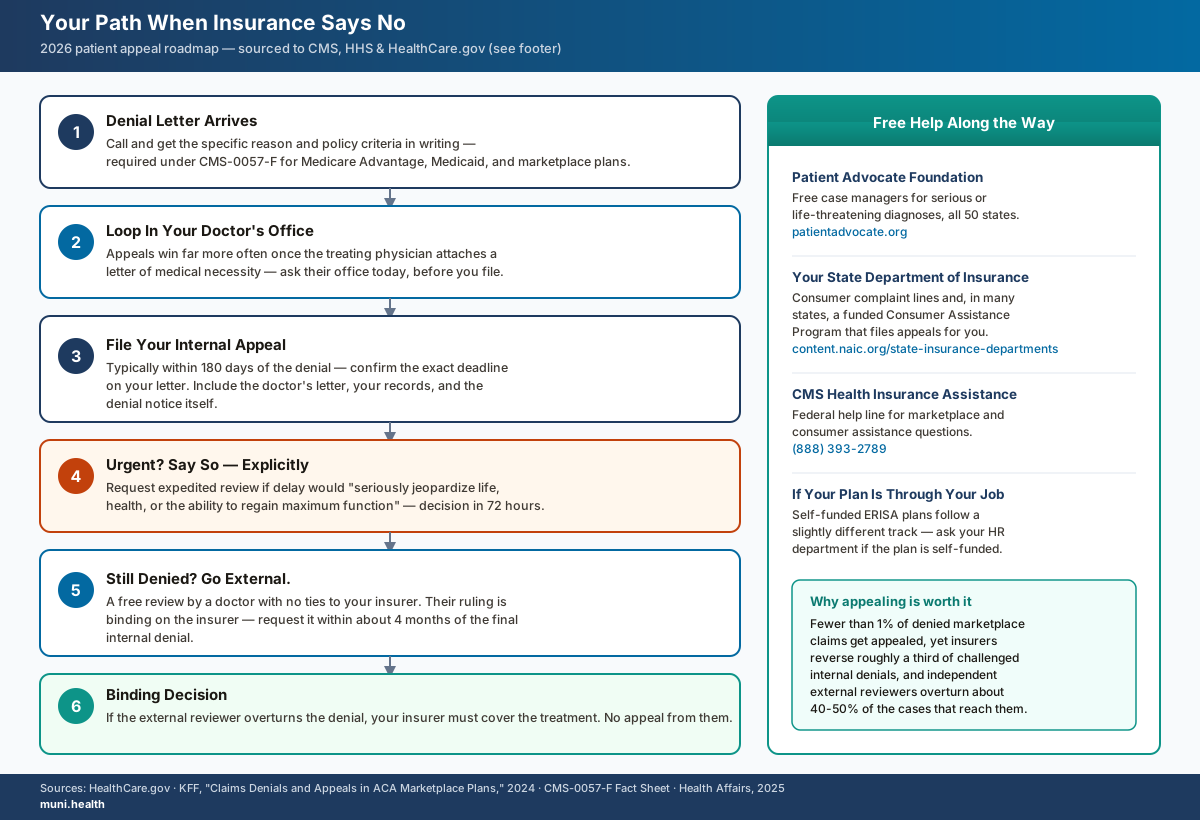
Step 1: Get the Real Reason in Writing
Call the number on your denial letter and ask directly for the specific clinical reason the treatment was denied, and which coverage policy or clinical criteria set was used to make that decision.
For Medicare Advantage, Medicaid managed care, and ACA marketplace plans, insurers are now required to give you a specific reason — not just a generic code — under the CMS Interoperability and Prior Authorization Final Rule (CMS-0057-F), effective January 1, 2026 (CMS, CMS-0057-F Fact Sheet). This requirement does not currently apply to prior authorization decisions for drugs, or to commercial self-funded employer plans.
Write down the date you called, who you spoke with, and exactly what they told you. This becomes the foundation of your appeal.
Step 2: Loop In Your Doctor's Office — Today
This is the single highest-leverage step, and the one people skip most often because they assume the insurance fight is theirs alone to handle.
Call your doctor's office, tell them the treatment was denied, and ask them to send a letter of medical necessity addressing the specific reason on the denial. For prior authorization denials, ask whether they can request a peer-to-peer review — a direct phone call between your doctor and the insurer's medical director, which resolves many denials in days rather than weeks.
Your doctor's staff deals with denials like yours constantly. Asking for help here is not an imposition — it's the fastest path to a reversal.
Step 3: File Your Internal Appeal Before the Deadline
Once you have the reason and your doctor's supporting letter, file the written internal appeal. The deadline and process vary by plan type — check your specific letter, since your plan may set a shorter or longer window than the general ranges below.
| Plan Type | Internal Appeal Deadline | External Review After That | Who Decides Externally |
|---|---|---|---|
| ACA marketplace / individual | 180 days from denial | ~4 months after final internal denial | State-certified independent reviewer |
| Employer plan (fully insured) | 180 days from denial | ~4 months after final internal denial | State-certified independent reviewer |
| Employer plan (self-funded/ERISA) | 180 days (check plan document) | Voluntary at most plans, ~4 months | Insurer-contracted independent reviewer |
| Medicare Advantage | 60 days from denial | Automatic if internal appeal is denied | C2C Innovative Solutions (Part C IRE, since May 1, 2026) |
| Medicaid managed care | Varies by state, commonly 60-90 days | State Fair Hearing / EQRO review | State-designated reviewer |
What to include in your written appeal:
- A copy of the denial letter
- Your doctor's letter of medical necessity
- Any relevant medical records, test results, or notes on treatments already tried
- The appeal letter itself, stating clearly that you are appealing and what you want them to approve
[Your Name]
[Your Address]
[Member ID: ___________]
[Date]
[Insurance Company Name]
Attn: Appeals Department
[Address from your denial letter]
RE: Formal Appeal of Denied Claim / Prior Authorization
Claim or Reference Number: ___________
Patient Name: ___________
Date of Service or Requested Service: ___________
To the Appeals Department:
I am writing to formally appeal your decision to deny [treatment or service name] under policy number ___________. I received a denial letter dated [date], which stated the following reason: "[quote the exact reason from your letter]."
I disagree with this decision. [In 2-3 sentences, explain in your own words why this treatment is necessary for your condition.]
Enclosed with this appeal:
- A letter of medical necessity from Dr. [name], my treating physician
- [List any additional records: test results, imaging, prior treatment history]
- A copy of the original denial letter
I am requesting that you reverse this denial and approve [treatment/service]. Please provide your written decision within the timeframe required by my plan and applicable law.
If a delay in deciding this appeal would seriously jeopardize my life, health, or ability to regain maximum function, please treat this as a request for expedited review.
Please contact me at [phone number] or [email address] if you need any additional information.
Sincerely,
[Your name]
[Date]
Prepare this appeal without starting from scratch.
Muni drafts the letter, surfaces payer-policy citations, and builds the evidence checklist. Your staff stays responsible for review and submission.
First 3 appeals free, then $20 per appeal. Start with your denial letter or EOB and available records. No meeting or clearinghouse connection required.
Send it by a method that gives you proof of delivery — certified mail, the insurer's appeal portal with a confirmation number, or fax with a confirmation sheet. Keep a copy of everything. For a full payer-by-payer breakdown of filing windows, see the insurance appeal deadlines guide.
Step 4: Urgent? Say So — Explicitly
If waiting for the standard decision timeline would seriously jeopardize your life, health, or your ability to regain maximum function, you can request expedited review at any stage — internal appeal or external review — and a decision is required within 72 hours (45 CFR 147.136; for Medicaid managed care, 42 CFR 438.410).
Use the Exact Legal Phrase
When you request expedited review, say the words "seriously jeopardize my life, health, or ability to regain maximum function" — not just "this is urgent." Insurers' intake teams have been documented downgrading vaguely worded urgency requests to standard review. The specific legal phrase is harder to wave off.
For the full expedited process, including what to do if your urgent request gets downgraded to standard review, see the urgent and expedited insurance appeal guide.
Step 5: Still Denied? You Get a Second Opinion They Don't Control
If your internal appeal is denied, you have the right to request an external review — a decision made by an independent physician or review organization with no financial relationship to your insurer. Their decision is legally binding on the insurer.
You generally have about four months from the date of your final internal denial to request it (HealthCare.gov, External Review). Independent external reviews overturn roughly 40-50% of the denials that reach them — a 2025 Health Affairs analysis of New York's external appeals found 46.7% were overturned in full or in part (Health Affairs, 2025).
If the Federal External Review Line Doesn't Work
Some denial letters direct you to the HHS-run Federal External Review Process. As of mid-2026, that federal process has experienced periods of disruption (HealthCare.gov). If the number or portal on your letter doesn't work, don't assume you've lost the right — follow the backup routing instructions in your final denial letter, or call your state Department of Insurance (below) to confirm where to send the request.
For a deeper walkthrough of the external review request process, see the independent review organization appeal guide.
Step 6: If Your Plan Is Through Your Job
If your insurance comes through an employer, ask your HR department whether the plan is "self-funded." Self-funded employer plans are regulated under ERISA and the Department of Labor rather than your state's insurance laws, which means external review is voluntary at the plan level rather than guaranteed by your state — though most large employer plans offer it anyway. The internal appeal process and deadlines are still spelled out in your plan document, and your rights to file are the same either way.
Prepare this appeal without starting from scratch.
Muni drafts the letter, surfaces payer-policy citations, and builds the evidence checklist. Your staff stays responsible for review and submission.
First 3 appeals free, then $20 per appeal. Start with your denial letter or EOB and available records. No meeting or clearinghouse connection required.
Can You Get Treatment While You Wait?
A denial stops your coverage — it doesn't have to stop your care. A few ways to keep moving while the appeal runs:
- Request expedited review if the delay would seriously jeopardize your health (Step 4).
- Ask your doctor about a covered alternative that can hold the line clinically without giving up your case for the originally requested treatment.
- Pay out of pocket and seek reimbursement if the appeal succeeds. Keep every receipt. Self-pay is billed at the uninsured rate, so ask your provider's billing office about a cash-pay discount before committing.
- For specialty drugs, ask your doctor's office about manufacturer patient assistance programs, or nonprofit copay-assistance funds such as the Patient Advocate Foundation's Co-Pay Relief program and the HealthWell Foundation.
- For emergencies, treatment proceeds regardless of prior authorization status — emergency services carry separate protections under federal law.
None of these replace the appeal. They buy time while it runs.
Free Help — You Don't Need to Pay Anyone for This
You don't have to do this alone, and you don't need a lawyer for a standard appeal.
- Patient Advocate Foundation — a national nonprofit offering completely free case managers to patients in all 50 states with a serious, life-threatening, or debilitating diagnosis. If your situation involves a complex or advanced condition — heart failure, cancer, a rare disease, multiple comorbidities — this is the resource built specifically for you: a case manager can work your appeal directly instead of you doing it alone. See also their guide to what to include in an appeal letter.
- Your state Department of Insurance — every state has a consumer complaint line, and many run a federally funded Consumer Assistance Program that will help file your appeal for you at no cost. Find your state's contact information through the NAIC state insurance department directory, and see the state-by-state insurance appeal laws guide for rules specific to where you live.
- CMS Health Insurance Assistance Team — (888) 393-2789, for questions about marketplace plans and Consumer Assistance Programs (CMS, Consumer Assistance Program).
What This Guide Isn't
This is administrative and procedural information, not medical or legal advice, and it doesn't replace the specific instructions on your own denial letter — those govern your actual deadlines. If your case involves ongoing litigation, a Medicare Advantage denial that has already gone through the Independent Review Entity, or a life-threatening timeline, the free resources above can get you dedicated, one-on-one help faster than continuing to search on your own.
Frequently Asked Questions
How long do I have to appeal a health insurance denial?
Most plans give you 180 days from the date of the denial letter to file an internal appeal, though Medicare Advantage is shorter, at 60 days. Check your specific denial letter — the deadline is legally required to be printed on it.
What's the difference between an internal appeal and an external review?
An internal appeal is reviewed by your own insurance company. An external review is decided by an independent physician or organization with no financial relationship to your insurer, and their decision is legally binding on the insurer. You generally must complete the internal appeal first, except in urgent cases.
Does it cost anything to appeal?
No. Filing an internal appeal and requesting external review are both free by law. Nonprofit help like the Patient Advocate Foundation is also free. The only cost patients typically incur is if they choose to pay out-of-pocket for treatment while an appeal is pending.
Can I still get my treatment while the appeal is pending?
Sometimes. You can request expedited review if a delay would seriously jeopardize your health, ask your doctor about a covered bridge treatment, or pay out-of-pocket and seek reimbursement if you win. Genuine emergencies are covered regardless of prior authorization status.
What if my insurance is through my employer?
Ask HR whether the plan is self-funded (governed by ERISA) or fully insured (governed by your state's insurance laws). Either way, your internal appeal rights and deadlines are in your plan document, though external review is guaranteed by your state only for fully insured plans — self-funded plans typically offer it voluntarily.
What if I have Medicare or Medicaid instead of a marketplace or employer plan?
Medicare Advantage denials escalate automatically to the Part C Independent Review Entity (currently C2C Innovative Solutions) if your internal appeal is denied — you don't have to separately request it. Medicaid managed care plans have a state fair hearing right after plan-level appeals are exhausted; the process and deadlines vary by state.
Do I need a lawyer to appeal?
No. The large majority of appeals are resolved without legal representation, especially with your doctor's office involved and a complete written appeal. Attorneys typically only become relevant after every appeal level, including external review, has been exhausted.
What if I already missed my appeal deadline?
Call your insurer and your doctor's office immediately — some plans allow a good-cause exception for a missed deadline, particularly if you weren't clearly notified of it. Your state Department of Insurance or a Patient Advocate Foundation case manager can also help you find out whether any option is still open.
A Note on Who Wrote This
If someone pointed you to this page after you reached out for help, that's likely us. Muni Health builds software that helps independent medical practices manage insurance appeals and paperwork — we don't handle individual patient appeals directly, but we see denial letters like yours every day, and wanted a straight answer to send when people ask. If your doctor's office is buried in this kind of paperwork on your behalf, they can look at Muni Appeals.
This guide reflects 2026 insurance appeal procedures and regulations, including CMS-0057-F requirements effective January 1, 2026. Deadlines, forms, and review processes vary by insurance company, plan type, and state — always follow the specific instructions on your own denial letter. This information is for administrative and procedural purposes only and is not medical or legal advice.