

A "provider not credentialed" denial (denial code CO-B7) means the insurer did not recognize the billing provider as enrolled at the date of service. These denials are appealable — they follow a different track than not-in-network denials. The appeal relies on proving the credentialing application was submitted and pending when services were rendered, using CAQH timestamps, NPI registry dates, and payer enrollment confirmation letters as evidence.
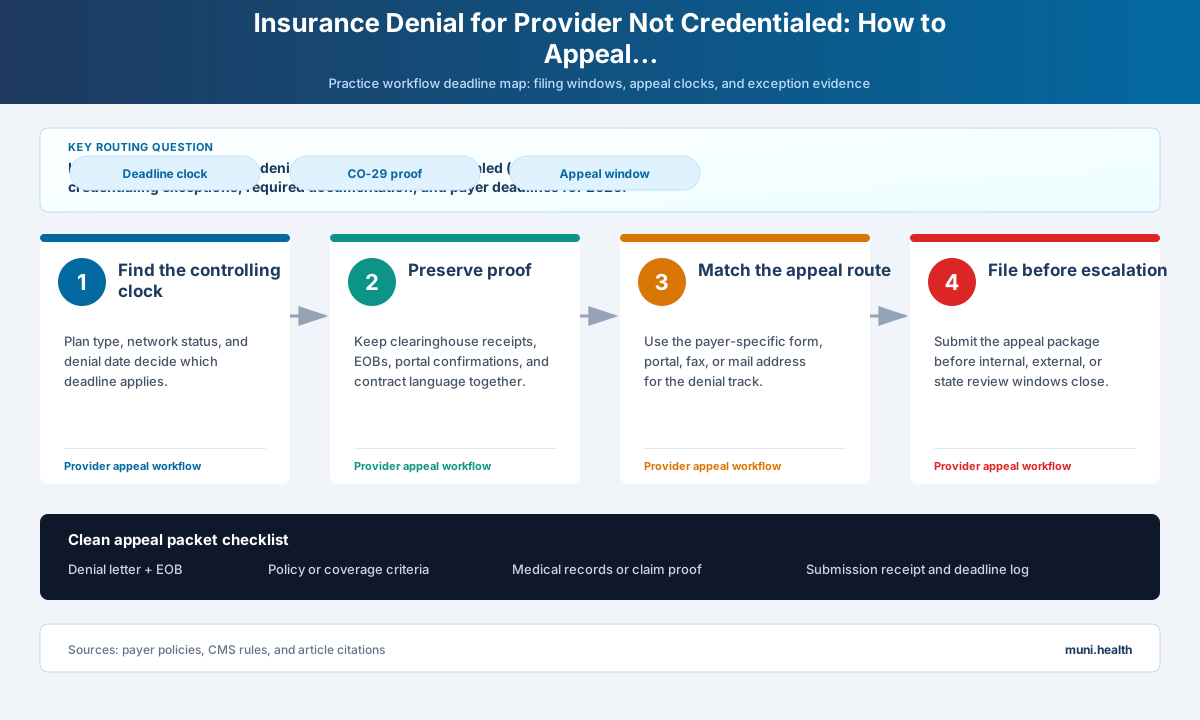
What a Credentialing Denial Actually Means
A credentialing denial is not the same as an out-of-network denial, and treating it like one is the most common appeal mistake practices make. Denial code CO-B7 ("This provider was not certified/eligible to be paid for this procedure/service on this date of service") shows up when the insurer has no active enrollment record for the billing or rendering NPI at the time of service — not necessarily because the provider is out of network.
The critical distinction: credentialing denials are usually administrative timing errors, not coverage exclusions. The provider is contracted or eligible to be contracted; the payer's system just didn't show it at the moment the claim was adjudicated. That makes these appealable through a different route — the provider enrollment or credentialing department, not the standard clinical appeal team — and often resolvable without a full clinical argument.
CO-B7 denials contribute to the overall insurance denial burden across all major payers — for a breakdown of how credentialing and administrative denials compare to clinical denials by insurer, see which insurance company denies the most claims.
Common root causes behind CO-B7 denials include:
- Claims submitted before the credentialing effective date — provider started seeing patients before payer enrollment confirmed
- Individual NPI vs. group NPI mismatch — provider is credentialed individually but the claim billed under the group NPI (or vice versa), and the payer's system treats these as separate enrollments
- CAQH profile expired — CAQH requires re-attestation every 120 days; an expired status suspends the payer's ability to verify the provider, and some payers auto-deny claims while the profile sits expired
- Taxonomy code mismatch — the taxonomy code on the claim doesn't match what's on file in NPPES or with the payer; UHC tightened its taxonomy matching logic in 2025 as part of its AI adjudication upgrade
- Group enrollment gap — an individual physician is credentialed, but the practice group entity (group NPI / Tax ID combination) was never separately enrolled; some payers require both
- Recredentialing lapse — the payer's periodic recredentialing window closed and no response was submitted, triggering an automatic enrollment suspension
CO-B7 vs PR-B7
When you see CO-B7, the adjustment is provider responsibility — the payer is saying the practice should not have billed. When you see PR-B7, patient responsibility is assigned instead. Most credentialing denials come back as CO-B7. If you receive PR-B7, verify whether the payer is attempting to balance-bill the patient, and correct course quickly — that patient responsibility assignment is generally inappropriate for a provider enrollment error.
The Timely Credentialing Exception
The most useful tool in a credentialing denial appeal is the timely credentialing exception — a reconsideration argument that the payer is obligated to honor enrollment retroactively to the application submission date because the delay was on the payer's side, not the provider's.
The argument has two required elements:
-
The provider submitted a complete credentialing application before the dates of service. You need a date-stamped record of application submission — not just that the application was eventually approved.
-
The payer's own processing timeline caused the effective date to land after the service dates. Standard commercial payer credentialing review runs 60–120 days. If the practice submitted in March and services were rendered in April, but the payer didn't complete credentialing until June, the services fell inside the pending window.
When both elements are true, insurers including Aetna, UHC, BCBS, and Cigna have accepted retroactive enrollment adjustments on appeal — though none of them publish this as a written policy in their provider manuals. The argument must be made explicitly in the appeal letter; the payer will not offer it automatically.
The Application Date Is Not the Effective Date
Payers set the credentialing effective date at the point when they complete their internal review, not when you submitted the application. The gap between submission and effective date is where CO-B7 denials happen. Your appeal must document the submission date — CAQH application timestamp, fax confirmation, or portal submission receipt — not just the final approval date.
Documentation Required for a Credentialing Denial Appeal
The appeal package for a CO-B7 denial is different from a medical necessity appeal. You're building an administrative evidence file, not a clinical one.
Core documentation:
- CAQH ProView application timestamp — log in to CAQH ProView and pull the attestation history. The timestamped attestation record shows when your profile was complete and when each payer access was authorized. This is your primary submission evidence.
- NPI registry confirmation from NPPES — download the NPI confirmation from nppes.cms.hhs.gov showing the provider's NPI, taxonomy code, and effective date. Verify the taxonomy code on the confirmation matches what's on your claim exactly.
- Payer enrollment acknowledgment letter or confirmation number — if the payer sent a written or portal confirmation that your application was received and under review, include it. Even an email confirmation with a case number works.
- Group enrollment confirmation — if the denial involves a billing NPI (group) rather than the rendering NPI, confirm the group NPI's enrollment record separately. Group and individual credentialing are independent at most payers.
- Timeline narrative — a short written summary (one page maximum) showing: application submission date, payer's estimated processing window (from their provider manual), the date of service in question, and the date credentialing was eventually confirmed. The visual gap makes the timely credentialing argument immediately legible.
Supporting documentation for specific root causes:
- CAQH expired profile: Print the CAQH re-attestation history showing the profile status on the date of service. If the profile lapsed due to CAQH's own notification failure (documented by CAQH outreach records), note that in the appeal.
- NPI/taxonomy mismatch: Include a side-by-side comparison of the taxonomy code on the claim vs. the taxonomy code registered in NPPES, plus the corrected NPPES record if you've updated it.
- Group enrollment gap: Include the group entity's separate enrollment application and confirmation alongside the individual provider's.
How to Structure the Appeal Letter
The appeal letter for a credentialing denial follows a different structure than a clinical appeal. Keep it short, factual, and focused on the enrollment timeline.
[Date]

[Payer Name] Provider Disputes / Provider Enrollment
[Mailing Address or Portal Submission]

Re: Credentialing Claim Denial Appeal
Provider: [Provider Full Name, NPI]
Group: [Group Name, Group NPI]
Patient: [Member ID]
Date of Service: [DOS]
Claim Number: [Claim Number]
Denial Code: CO-B7

Dear Provider Disputes Team:

We are writing to appeal the denial of the above-referenced claim under
denial code CO-B7 ("provider not certified/eligible").

[Provider name] submitted a complete credentialing application to [Payer]
on [application submission date], as evidenced by the enclosed CAQH
attestation record dated [date] and payer enrollment acknowledgment
reference [#]. The date of service ([DOS]) falls within [Payer]'s standard
credentialing review window of [60–90/120] days.

The denial reflects a processing timeline gap on [Payer]'s end, not a
failure to credential. We request that [Payer] apply retroactive enrollment
to [application submission date] and reprocess this claim accordingly.

Enclosed:
- CAQH ProView attestation history (application timestamp: [date])
- NPPES NPI registry confirmation for [Provider NPI]
- [Payer] enrollment acknowledgment / application reference [#]
- Enrollment timeline summary

Please direct any questions to [Billing Contact Name] at [Phone] / [Email].

Respectfully,
[Authorized Representative Name]
[Practice Name]
[Contact Information]
Skip the blank template. Start with a review-ready draft.
Use the template as guidance, or let Muni prepare a payer-specific draft for your team to verify, sign, and submit.
First 3 appeals free, then $20 per appeal. Start with your denial letter or EOB and available records. No meeting or clearinghouse connection required.
Payer-Specific Appeal Tracks and Deadlines
Each major insurer routes credentialing denials differently from clinical denials. Submitting to the wrong team delays resolution significantly. Deadlines below are for commercial plans — for full payer-specific deadlines by plan type, see the insurance appeal deadlines guide.
| Insurer | Appeal Route | Where to Submit | Commercial Deadline | Notes |
|---|---|---|---|---|
| Aetna | Provider Disputes (not standard clinical appeal) | Availity portal (Provider Disputes) or mail to address on denial letter; NaviNet for some accounts | 180 days from denial date | If CAQH-related: contact Aetna Provider Data Management separately; Aetna Medicaid uses state-specific provider services |
| UnitedHealthcare | Provider Dispute Resolution | UHCProvider.com Provider Dispute portal | 65 days from denial date — shortest window of any major payer | UHC tightened NPI/taxonomy matching in 2025; verify both rendering and billing NPI enrollments separately before submitting |
| BCBS (affiliates vary) | Provider Disputes / Provider Enrollment Reconsideration | Availity or the affiliate-specific provider portal; address on denial letter | Typically 180 days; verify with the specific affiliate | BlueCard claims: dispute routes to the HOME plan, not the host plan — confirm before submitting |
| Cigna | Provider Disputes via Availity | Availity Essentials Provider Disputes section | 180 days from denial date | If taxonomy mismatch: update CAQH first, then file dispute citing corrected taxonomy; Cigna can take 60–90 days to process enrollment updates |
| Humana | Provider Dispute / Enrollment Correction | Availity or Humana Provider Portal (availity.com) | 180 days from denial date | Humana Medicare Advantage: credentialing disputes route separately through Humana's MA provider enrollment team |
The UHC 65-day window is the critical outlier. A practice that discovers a CO-B7 denial from UHC 70 days after the denial date has no administrative appeal path remaining. For UHC specifically, audit claim ERAs weekly and catch CO-B7 denials within 30 days of denial to leave adequate preparation time.
When to Route Through Credentialing vs. Claims
The right team depends on the underlying cause of the denial.
Route through the credentialing / provider enrollment department when:
- The provider's CAQH profile was complete and attested but the payer's system hasn't reflected the update
- The effective date needs to be adjusted retroactively to match the application date
- A group NPI enrollment was never completed and needs to be initiated
- Recredentialing lapsed and the payer deactivated the enrollment — this is a reinstatement, not an appeal
Route through claims / provider disputes when:
- The denial is clearly an NPI mismatch on the claim itself (billing vs. rendering NPI transposition) — this is often a corrected claim, not a formal appeal
- The claim was submitted with an incorrect taxonomy code and the correct code needs to be resubmitted
- The credentialing record is confirmed complete but the claim adjudication didn't pick it up — the claims team can force-adjudicate
In practice, the fastest resolution for most CO-B7 denials involves contacting both departments: the enrollment team to confirm or correct the effective date, and the claims team to track the appeal and trigger reprocessing once enrollment is confirmed.
Corrected Claim vs. Formal Appeal
If the CO-B7 denial resulted from a billing error — wrong NPI, wrong taxonomy code — the fastest fix is often a corrected claim (claim frequency type code 7), not a formal appeal. A formal appeal asks the insurer to reconsider their decision; a corrected claim replaces the original with accurate data. For clean billing errors, submit the corrected claim first. If the payer rejects the corrected claim as outside the timely filing window, then escalate to a formal appeal with documentation that the original claim was timely filed. See the corrected claim vs insurance appeal guide for the full decision tree.
How Muni Appeals Handles Credentialing Denials
Credentialing denials require a different documentation workflow than medical necessity or prior authorization denials. The appeal isn't about clinical evidence — it's about assembling enrollment records, timestamps, and NPI data before the appeal window closes.
Prepare this appeal packet with your team.
Draft the appeal, coordinate missing documents, and approve the reviewed packet. Keep your clearinghouse; your practice checks deadlines and submits through the payer’s accepted channel.
First 3 appeals free, then $20 per appeal. Start with your denial letter or EOB and available records. No meeting or clearinghouse connection required.
Muni Appeals helps billing teams:
- Surface likely CO-B7 credentialing-denial context for staff verification
- Organize uploaded CAQH, NPI, and enrollment evidence into a review-ready appeal package
- Generate an appeal draft with likely payer-specific routing guidance for staff verification
- Surface payer-specific deadline risk from uploaded notices for staff verification and calendaring
Frequently Asked Questions
What is denial code CO-B7?
CO-B7 means "This provider was not certified/eligible to be paid for this procedure/service on this date of service." It's the standard denial code for provider credentialing and enrollment-related claim denials — the payer is saying it had no valid enrollment record for the billing or rendering NPI at the time the service was rendered.
Is a CO-B7 credentialing denial the same as an out-of-network denial?
No — and confusing them leads to the wrong appeal track. An out-of-network denial means the provider is not in the insurer's contracted network and the patient's plan either doesn't cover out-of-network services or covers them at a lower rate. A CO-B7 credentialing denial means the payer's system didn't recognize the provider's enrollment record at adjudication — often a timing or data mismatch, not a network status issue. The appeal for CO-B7 goes through the provider enrollment or disputes team, not the clinical appeal team.
Can credentialing denials be appealed retroactively?
Yes, in many cases. The timely credentialing exception argument — which asks the payer to retroactively apply the enrollment effective date to the application submission date — has worked for practices at Aetna, UHC, BCBS, and Cigna. The two requirements are a complete application submitted before the dates of service, and documentation proving the delay was on the payer's processing side. Retroactive Medicare enrollment is also available: CMS allows providers to request a retroactive effective date up to 30 days before the application receipt date.
How do I prove when I submitted my credentialing application?
The most reliable evidence is the CAQH ProView attestation timestamp — your CAQH profile records the date and time each attestation was completed and each payer was authorized to access your profile. Log in to CAQH ProView, navigate to your attestation history, and download the record. For payer-direct applications (when you submitted a paper or portal application directly to the insurer), use the submission confirmation number, portal receipt, or fax confirmation as date evidence.
Why does CAQH expiration cause CO-B7 denials?
CAQH requires every provider to re-attest their profile every 120 days. If the re-attestation deadline passes without action, CAQH marks the profile as "Expired," and payers that use CAQH for primary source verification can no longer pull current data. Some payers respond by suspending claim adjudication for that NPI until a valid attestation is on file. A lapsed CAQH profile is one of the most preventable causes of CO-B7 denials — set a calendar reminder at 90 days from each attestation to allow buffer time before the 120-day window closes.
What if the denial is from a mismatch between the individual NPI and the group NPI?
This is one of the most common CO-B7 root causes and is usually fixable through a corrected claim rather than a formal appeal. Verify which NPI was submitted on the claim (Box 24J for rendering NPI, Box 33a for billing/group NPI on a CMS-1500). If the wrong NPI type was used, resubmit as a corrected claim with the correct NPI. If the group NPI itself is not enrolled with the payer, you'll need to initiate group enrollment — claims submitted under an unenrolled group NPI will keep denying until the group entity is on file.
How long do I have to appeal a CO-B7 denial?
The appeal window depends on the insurer and plan type. For most commercial plans: Aetna (180 days), BCBS affiliates (180 days), Cigna (180 days), Humana (180 days). UnitedHealthcare is the critical exception at 65 days from the denial date for all plan types. Medicare Part B and Medicare Advantage follow CMS-mandated windows. Because credentialing denials often aren't noticed until they're batched in an ERA audit, the 65-day UHC window deserves immediate attention — audit UHC ERAs weekly to avoid aging out.
When should I involve the payer's credentialing department directly rather than filing a formal appeal?
Involve the credentialing department directly when: (1) the provider has never been enrolled and the denial is the first signal of the gap — this needs a new enrollment, not an appeal; (2) a recredentialing lapse caused the denial — you need reinstatement, not reconsideration; (3) a CAQH expiration created a data gap the payer can correct once the profile is re-attested. For these situations, filing a formal claims appeal without first fixing the underlying enrollment record is circular — the appeal will deny again because the enrollment gap still exists.
Ready to Recover Credentialing Denials Before They Age Out?
CO-B7 denials have a narrow window and a documentation-specific appeal track that most billing teams aren't set up to handle at scale. The appeal isn't hard once you have the right records — CAQH timestamp, NPI confirmation, enrollment timeline — but pulling those documents for every denial across multiple payers is time-intensive work.
Get Started:
- Candidate CO-B7 and enrollment-appeal context for staff verification
- CAQH and NPI documentation compilation for each denial
- Payer-specific appeal letter generation with correct routing
- 65-day UHC window tracking and alert system for credentialing denials
- Multi-payer workflow covering Aetna, BCBS, UHC, Cigna, and Humana
This guide reflects the 2026 payer sources reviewed for publication. Credentialing appeal deadlines, enrollment processes, and exceptions vary by plan type, state, and contract. Verify current requirements in the denial letter and provider agreement before filing.