

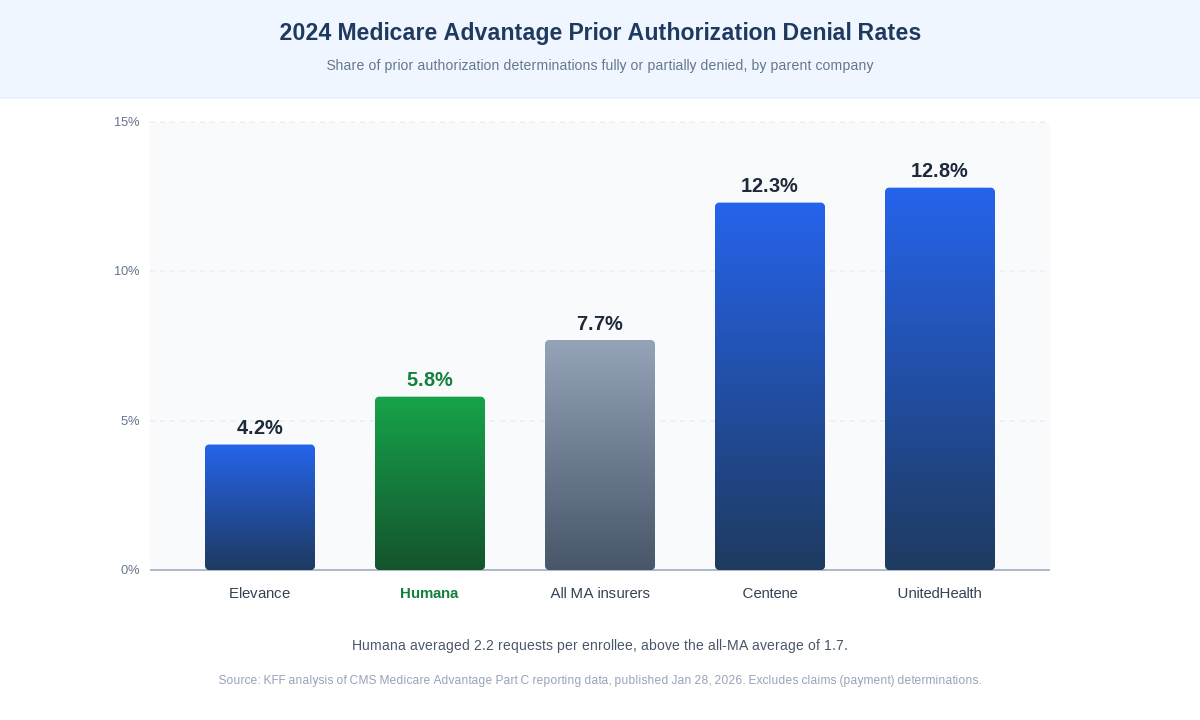
What is Humana's denial rate? The most comparable public figure is a Medicare Advantage prior-authorization rate, not a claim denial rate. In KFF's analysis of CMS data, Humana fully or partially denied 5.8% of Medicare Advantage prior-authorization requests in 2024, below the 7.7% average across all MA insurers. Humana averaged 2.2 requests per enrollee, above the 1.7 MA-wide average. Humana's own 2025 contract reports show the rate varies by contract, by standard versus expedited request, and by market.
Why Humana's Denial Data Looks Different From Other Insurers'
Humana has no current ACA Marketplace claim-denial figure, which is the dataset most other insurer denial-rate pages use. Humana announced on February 14, 2017 that it would stop selling individual plans, on and off the exchanges, for 2018. The KFF marketplace claim tables used on our UnitedHealthcare, Aetna and Cigna pages cover HealthCare.gov issuers, so they offer no Humana comparison.
Humana's published numbers come from Medicare Advantage and Medicaid prior authorization. That matches where its members are. Humana's third-quarter 2026 results report 7,185,200 Medicare Advantage members (individual plus group) and 18,038,700 total medical members as of September 30, 2026.
Prior authorization is not the same as a claim denial
A prior-authorization denial rate measures requests to approve care before it happens. A claim denial rate measures bills for care already delivered. KFF's Medicare Advantage data "does not include claims determinations." Never compare Humana's prior-authorization rate with another insurer's claim denial rate.
Humana's 2024 Medicare Advantage Prior Authorization Denial Rate
In 2024, Humana denied 5.8% of the Medicare Advantage prior-authorization requests it decided. That puts it below the 7.7% MA-wide rate and well below UnitedHealth Group (12.8%) and Centene (12.3%), according to KFF's January 28, 2026 analysis of CMS Part C reporting data.
Prepare this appeal packet with your team.
Draft the appeal, coordinate missing documents, and approve the reviewed packet. Keep your clearinghouse; your practice checks deadlines and submits through the payer’s accepted channel.
Try Muni Appeals FreeFirst 3 appeals free, then $20 per appeal. Start with your denial letter or EOB and available records. No meeting or clearinghouse connection required.
| 2024 Medicare Advantage metric | Humana | All MA insurers | What it measures |
|---|---|---|---|
| Prior-authorization denial rate | 5.8% | 7.7% | Requests fully or partially denied |
| Requests per enrollee | 2.2 (above the MA-wide average) | 1.7 | How often prior authorization is required, not how often it is denied |
| Denials that were appealed | Shown only in KFF's chart | 11.5% | Share of denied requests that reached an appeal |
| Appealed denials overturned | Shown only in KFF's chart | 80.7% | Among appealed denials only |
| Total determinations | Not stated in text | 52.8 million | All MA insurers |
Key takeaway: a below-average denial rate and an above-average request volume can be true at the same time. Humana had more requests per enrollee than the MA-wide average in 2024, so a practice can see a lot of Humana prior-authorization work even though a smaller share of it is denied.
KFF's caveats matter here. The data is reported by contract and rolled up to the parent company. It excludes withdrawn and dismissed requests. It also has no breakdown by service or plan type, because CMS does not collect that.
Humana's 2025 Prior Authorization Metrics, Contract by Contract
Since 2026, Humana publishes prior authorization results for each Medicare Advantage contract and each Medicaid state. It does this to comply with the CMS Interoperability and Prior Authorization final rule (CMS-0057-F). Humana's August 2026 prior-authorization announcement says these reports include approval and denial rates, approvals after appeal, and the average time to a decision. The reports are linked from Humana's prior authorization metrics page.
Two of those 2025 reports show how far the numbers move with the contract and the request type:
| 2025 metric (Humana report) | Medicare Advantage contract H1036 | Florida Medicaid |
|---|---|---|
| Standard requests | 1,303,837 | 746,974 |
| Standard requests denied | 7.02% (91,491) | 2.56% (19,097) |
| Expedited requests | 10,354 | 9,365 |
| Expedited requests denied | 17.36% (1,797) | 40.86% (3,827) |
| Appeals of standard denials approved | 55.73% (870 of 1,561) | 7.60% (190 of 2,499) |
| Mean / median standard decision time | 1 day / 0 days | 1 day / 1 day |
| Mean / median expedited decision time | 9 hours / 0 hours | 13 hours / 3 hours |
Sources: Humana H1036 2025 report and Humana Florida 2025 report. Each report notes that "an overturn on appeal does not necessarily indicate an inappropriate initial prior authorization decision," because new information may arrive with the appeal.
Three things stand out for a billing team:
- Expedited requests were denied more often than standard ones in both reports. KFF's August 13, 2026 review of the 2025 metrics noted the same pattern at the parent-company level: "CVS and Humana had higher denial rates for expedited requests than standard requests."
- Appeal outcomes differed sharply by market. More than half of appealed standard denials were approved under contract H1036, compared with fewer than 1 in 13 in Florida Medicaid.
- One contract is not Humana. Humana publishes a separate report for each MA contract and Medicaid state. Pull the report for the contract printed on the member's ID card or denial notice before drawing conclusions.
For context, KFF's 2025 review found Medicare Advantage standard-request denial rates ranging from 5% (Elevance) to 17% (UnitedHealth Group) across the six insurers it reviewed, with a 12% average. KFF warns that the 2025 metrics are reported as percentages, with definitions that are not fully standardized across insurers.
Post-Acute Care: Where Humana's Denial Rates Are Highest
Humana's denial rates for post-acute admissions are far higher than its overall rate. That comes from two federal reviews:
| Finding | Period | Source |
|---|---|---|
| Humana's post-acute prior-authorization denial rate was more than 16 times its overall denial rate | 2022 | Senate Permanent Subcommittee on Investigations, Refusal of Recovery (Oct 2024) |
| Humana denied 6.3% of skilled nursing facility (SNF) prior-authorization requests | 2022 | Same PSI report, as cited in the subcommittee's July 14, 2026 letter |
| Humana denied 13.5% of SNF prior-authorization requests | Requests processed June 2024 | HHS-OIG OEI-09-24-00331 (June 2026) |
| Humana denied 53.5% of inpatient rehabilitation facility (IRF) admission requests (2,366 of 4,419) | Requests processed June 2024 | HHS-OIG OEI-09-24-00330, Appendix C (June 2026) |
Sources: AHA summary of the PSI report, the PSI report, the subcommittee's July 14, 2026 letter to Humana, HHS-OIG OEI-09-24-00330, Appendix C (IRF data) and HHS-OIG OEI-09-24-00331.
These figures cover narrow slices of care, and the OIG reviews looked at one month of requests. They are not Humana's overall denial rate. But if your practice refers patients to SNFs, IRFs or long-term acute care hospitals, these are the requests most likely to come back denied. The SNF report's own title says Medicare Advantage organizations "overturned nearly all appealed prior authorization denials" for SNF admission, which makes the appeal itself the step that matters.
What Humana Says Is Changing in 2026
Humana has made public commitments that affect turnaround more than denial rates. In its August 2026 announcement, Humana says:
- Starting January 1, 2026, it decides at least 95% of complete electronic prior-authorization requests within one business day.
- Across 2024 and 2025, it removed prior-authorization requirements for more than 340 codes, including colonoscopies, transthoracic echocardiograms and select CT and MRI scans.
- It plans a gold card program in 2026 that waives prior authorization for certain services for providers whose requests consistently meet medical criteria.
Separately, CMS-0057-F requires Medicare Advantage and Medicaid managed care plans to decide standard prior-authorization requests within 7 calendar days and expedited requests within 72 hours, starting January 1, 2026. Humana's own reports repeat those clocks. These are decision deadlines for the initial request, not appeal deadlines.
How to Use These Numbers on a Humana Denial
A denial rate tells you how common a denial is. It does not tell you whether your denial is right. Use the data to set priorities, then work the specific notice.
1. Identify the market and the request type
Check whether the denial is Medicare Advantage, Medicaid or another product, and whether it was a standard or expedited request. Humana's 2025 data shows expedited denials and appeal outcomes vary widely between these.
2. Review the appeal options on post-acute and expedited denials
Check the clinical record, denial reason and urgency before deciding whether to appeal. Across all MA insurers and service types in 2024, only 11.5% of prior-authorization denials were appealed, and 80.7% of appealed denials were partially or fully overturned (KFF). Those aggregate figures do not establish a success rate or ranking for post-acute or expedited appeals.
3. Match the record to the cited criterion
The denial notice names the Humana Medical Coverage Policy or Medicare criterion applied. Answer each element of that criterion from the chart. The Humana prior authorization denial appeal guide walks through the routing, and the Humana appeal letter template gives you the letter.
4. File on the right clock
For Medicare Advantage enrollee or representative reconsiderations, CMS Part C guidance sets 65 calendar days from the date of the organization-determination notice. Provider payment disputes follow their applicable contract and notice instructions; Medicaid and other products have separate rules. For claim-side deadlines, see Humana Medicare Advantage timely filing.
Muni Appeals drafts the appeal letter and evidence checklist from the denial and records you upload. It does not guarantee an outcome, and you still verify the plan, deadline and filing address on the notice.
→ Prepare a Humana Appeal With Muni
Frequently Asked Questions
Prepare this appeal packet with your team.
Draft the appeal, coordinate missing documents, and approve the reviewed packet. Keep your clearinghouse; your practice checks deadlines and submits through the payer’s accepted channel.
Try Muni Appeals FreeFirst 3 appeals free, then $20 per appeal. Start with your denial letter or EOB and available records. No meeting or clearinghouse connection required.
What percentage of claims does Humana deny?
No public dataset reports a current Humana claim denial rate across all products. The comparable public figure is prior authorization: Humana denied 5.8% of Medicare Advantage prior-authorization requests in 2024, against a 7.7% MA-wide average (KFF). Humana left the individual ACA market for 2018, so it has no figure in the ACA Marketplace claim data used for other insurers.
Is Humana's denial rate higher than UnitedHealthcare's?
Not for Medicare Advantage prior authorization in 2024. KFF reports 5.8% for Humana and 12.8% for UnitedHealth Group. In KFF's 2025 review, UnitedHealth Group had the highest MA standard-request denial rate (17%) of the six insurers reviewed. See UnitedHealthcare denial rate statistics and the insurance denial rate comparison by company.
How often does Humana require prior authorization?
In 2024, Humana averaged 2.2 Medicare Advantage prior-authorization requests per enrollee, above the 1.7 average across all MA insurers (KFF). Humana says it removed prior authorization for more than 340 codes across 2024 and 2025.
What percentage of Humana appeals are successful?
It depends on the contract and market. Humana's 2025 reports show 55.73% of appealed standard denials approved under Medicare Advantage contract H1036, and 7.60% under Florida Medicaid. Across all MA insurers in 2024, 80.7% of appealed prior-authorization denials were partially or fully overturned (KFF).
Why are Humana's post-acute care denials so high?
The Senate PSI report found Humana's 2022 post-acute denial rate was more than 16 times its overall rate. For requests processed in June 2024, HHS-OIG Appendix C reports Humana denied 53.5% of IRF admission requests; the separate SNF review reports 13.5%. OIG said it was "unclear why" some insurers' rates were much higher than their peers'. Neither report sets a denial rate for your specific request.
Where can I find Humana's prior authorization data for my patient's plan?
Use the contract number on the member's ID card or the denial notice. Humana posts a separate 2025 report for each Medicare Advantage contract and each Medicaid state on its prior authorization metrics page. For the request itself, see the Humana prior authorization form guide.
The Bottom Line
- Humana's most comparable public denial rate is 5.8% for 2024 Medicare Advantage prior authorization, below the 7.7% MA average (KFF).
- Humana's prior-authorization request volume was above the MA-wide average in 2024: 2.2 requests per enrollee versus 1.7.
- Humana's 2025 contract reports show expedited requests denied more often than standard ones, and appeal approval ranging from 55.73% (MA contract H1036) to 7.60% (Florida Medicaid).
- In OIG's June 2024 IRF data, Humana denied 53.5% of admission requests; this is a care-setting-specific figure.
For every Humana denial, work from the notice: the cited criterion, the product, and the appeal deadline. For classification by denial type, see the Humana denied claim guide. For the full process, see how to appeal Humana denials.
Sources: KFF, Medicare Advantage Insurers Made Nearly 53 Million Prior Authorization Determinations in 2024 (Jan 28, 2026), KFF, Prior Authorization Metrics Provide New Insights into Insurer Practices, but Gaps Remain (Aug 13, 2026), Humana H1036 2025 prior authorization metrics, Humana Florida 2025 prior authorization metrics, Humana, Making Healthcare Work Better by Modernizing Prior Authorization (Aug 2026), Humana Q3 2026 results (SEC), Senate PSI, Refusal of Recovery (Oct 2024), Senate PSI letter to Humana (Jul 14, 2026), HHS-OIG OEI-09-24-00330, HHS-OIG OEI-09-24-00331, CMS Part C reconsideration guidance, CNBC on Humana's 2018 exchange exit (Feb 14, 2017)
This article is for administrative and educational purposes. It is not legal or medical advice. Plan rules, deadlines and filing addresses vary; the denial notice and current plan documents control.