

Dental insurance denials cluster around four ADA code categories: periodontal scaling (D4341/D4342), crown coverage (D2750/D2751), alveoloplasty (D7310), and radiograph frequency limits (D0220/D0274). Nearly 1 in 5 dental claims is denied on first submission in 2026. Each category has predictable documentation gaps — pocket depth charting for SRP, structural x-rays for crowns, procedural distinctness narratives for alveoloplasty — that determine whether an appeal succeeds.
Why Dental Claim Denial Rates Are Rising in 2026
Dental claim denials have reached their highest rates in years. According to dental billing industry data reported through 2025, at least 15% of received dental claims are denied — up roughly four percentage points from 2022 — and nearly 1 in 5 claims is denied on first submission.
Several factors are converging in 2026:
CDT code updates. The 2026 CDT code set added 60 new codes. Practices relying on pre-2026 code mappings saw a 34% spike in denial rates in Q1 2026, according to dental AI billing industry reporting. Code accuracy is now a direct predictor of first-pass acceptance rates.
Expanded documentation requests. Major dental payers — Delta Dental, MetLife, Cigna, Aetna, and United Concordia — have expanded pre-payment documentation requirements for periodontal, major restorative, and oral surgery procedures. Periodontal charting, periapical radiographs, and pre-operative photographs that were optional attachments two years ago are now routinely required at submission.
AI-assisted claim screening. The same algorithmic review tools entering medical insurance billing (discussed in our guide on AI-driven insurance denials) are being deployed by dental payers to flag claims for review before payment. Documentation that doesn't match clinical expectations triggers holds before a human reviewer sees the claim.
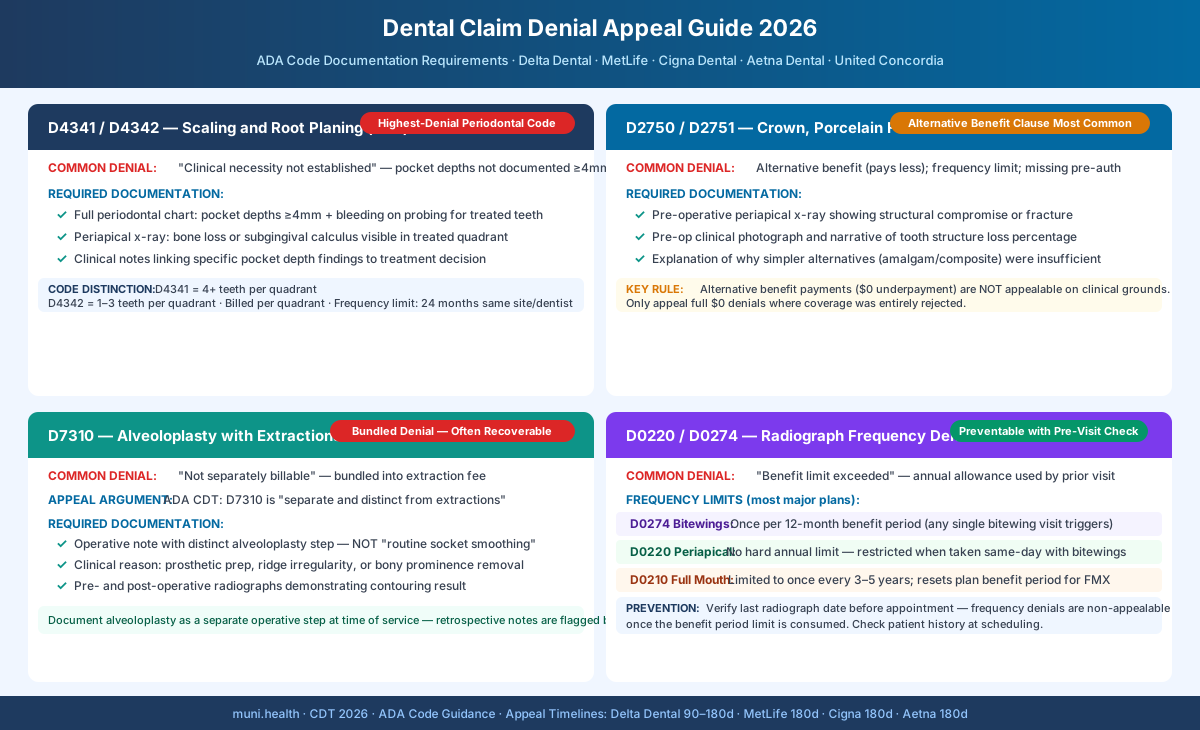
The 4 ADA Code Categories with the Highest Denial Rates
Dental denials concentrate in four predictable code clusters — understanding each cluster's root cause determines the appeal strategy. Random denials do exist, but the vast majority of recoverable dental claim denials fall into the categories below.
| ADA Code(s) | Procedure | Most Common Denial Reason | Primary Fix |
|---|---|---|---|
| D4341 / D4342 | Scaling and Root Planing (SRP) | Clinical necessity not established — pocket depths below threshold or charting missing | Full periodontal chart with ≥4mm depths, bleeding on probing, radiographic bone loss |
| D2750 / D2751 | Crown — Porcelain Fused to Metal | Alternative benefit clause; frequency limitation; missing pre-authorization | Pre-op periapical x-ray, clinical photograph, narrative documenting structural compromise |
| D7310 | Alveoloplasty with Extractions | Denied as included in extraction fee — 'not separately billable' | Operative note documenting non-routine bone contouring distinct from socket smoothing |
| D0220 / D0274 | Periapical and Bitewing Radiographs | Frequency limit exceeded; peri overlap with same-day bitewings at recare | Pre-visit benefit verification; clinical indication note for problem-focused imaging |
The ADA's Responding to Claim Rejections guidance confirms that insufficient documentation is the leading root cause across all four categories — the clinical finding exists, but the record submitted to the payer does not reflect it clearly enough.
D4341 and D4342: Scaling and Root Planing Denials
SRP denials are almost always documentation failures, not coverage exclusions. The clinical procedure is covered under virtually all major dental plans — the denial language "clinical necessity not established" means the submitted record did not show the required periodontal disease findings, not that the procedure is uncovered.
D4341 vs. D4342 — get the code right first: D4341 applies when four or more teeth in a quadrant require SRP. D4342 applies when one to three teeth in that quadrant require SRP. Both codes are billed per quadrant. Applying D4341 when only two teeth in a quadrant were treated is a coding error that triggers denial and can flag the account for audit.
What documentation payers require for D4341/D4342:
- Full periodontal chart with six-site per tooth measurements for all teeth in the treated quadrant — most payers require documented depths of 4mm or greater with bleeding on probing at two or more sites in the treated quadrant
- Periapical radiograph showing bone loss or subgingival calculus deposits in the treated quadrant
- Clinical notes documenting the active periodontal disease finding and the treatment rationale that links specific pocket depth measurements to the SRP decision
24-Month Rebilling Rule
Under ADA CDT guidelines, D4341 fees are not billable to patients within 24 months by the same dentist for the same site when a contractual limitation applies. Delta Dental, MetLife, and United Concordia all enforce this window. Frequency limit disputes require showing either a different treatment site or documenting disease recurrence sufficient to justify re-treatment within the restriction period.
Appeal narrative for SRP clinical necessity denial:
I am appealing the denial of D4341/D4342 for [patient name] on [date of service].

Clinical findings at examination:
— Pocket depths: [list specific tooth numbers and pocket depth measurements
  for each affected site, e.g., "Tooth #3: DB 5mm, B 6mm, MB 5mm;
  Tooth #4: DB 4mm, B 5mm, MB 4mm"]
— Bleeding on probing: [document which sites]
— Clinical attachment loss: [measurements where applicable]
— Radiographic findings: [describe bone loss or calculus visible
  on periapical x-ray for the treated quadrant]

Full periodontal chart, periapical radiograph, and clinical notes
documenting the above findings are attached. The clinical record
satisfies the plan's criteria for active periodontal disease in the
treated quadrant. I request reconsideration and payment of this claim.
Skip the blank template. Start with a review-ready draft.
Use the template as guidance, or let Muni prepare a payer-specific draft for your team to verify, sign, and submit.
D2750 and D2751: Crown Coverage Denials
The most common crown denial is not a coverage exclusion — it is an alternative benefit clause, and the two require completely different responses. Delta Dental, MetLife, and most Aetna Dental plans pay a crown benefit at the rate of a less expensive covered alternative. The actual crown placed (D2750 or D2751) is acknowledged; the payer just pays as if a lower-cost procedure were performed. This is a contractual limitation on most in-network agreements and is not appealable on clinical grounds.
What is appealable:
- Structural necessity denials ($0 payment): If the payer denies the crown entirely on grounds that medical necessity was not established, the appeal must document structural compromise of the tooth — not just that a crown was the preferred treatment.
- Frequency limitation override: Most plans limit crowns to once every 5 years per tooth. Replacement within that period requires documentation that the existing crown failed — fracture, recurrent decay under the margin, or material failure — supported by a current periapical x-ray and clinical photograph.
- Missing pre-authorization: Cigna Dental, Aetna Dental, and United Concordia require prior authorization for crowns above certain benefit thresholds. A denial for missing pre-auth requires either showing that pre-auth was obtained and not documented correctly, or filing for retroactive authorization with clinical justification.
Alternative Benefit vs. Full Denial
Before writing an appeal, confirm what type of denial you received. If the EOB shows a payment amount (even a reduced one), that is likely an alternative benefit clause — contractually not reversible. If the EOB shows $0 payment with a coverage denial code, that is a full denial — appealable with clinical documentation. Appealing an alternative benefit clause rarely produces a different result and consumes appeal cycle time.
Appeal narrative for crown structural necessity denial:
I am appealing the denial of D2750 (Crown — Porcelain Fused to High Noble Metal)
for [patient name], tooth [#], date of service [date].

Clinical basis for crown necessity:
— Existing restoration status: [cracked, fractured margins, recurrent decay —
  describe specifically with location and extent]
— Structural compromise: [percentage of tooth structure lost; cusp fracture;
  post-endodontic treatment requiring full coverage]
— Alternatives considered and excluded: [explain why amalgam or composite
  was insufficient given remaining tooth structure]

Attached: pre-operative periapical radiograph dated [date], pre-operative
clinical photograph, and clinical notes documenting the above findings.

I request reversal of this denial and payment at the D2750 benefit level.
D7310: Alveoloplasty Denials
D7310 alveoloplasty denials rest on a factual dispute the ADA CDT code language already settles in the provider's favor — but winning requires an operative note that documents the procedure as genuinely distinct from routine socket care.
Payers deny D7310 as "not separately billable" because routine socket smoothing after an extraction is considered part of the extraction procedure. That is accurate for routine post-extraction socket management. D7310 is correctly billed — and fully defensible on appeal — when additional bone recontouring beyond routine extraction was performed: preparation for immediate prosthetic placement across multiple sites, removal of a bony prominence (exostosis or torus) that is clinically distinct from the extraction, or ridge leveling that required a separate operative step.
The operative note is everything. A note that reads "routine extraction with socket smoothing" cannot support a D7310 appeal regardless of what was actually performed. The note must document the alveoloplasty as a distinct step — the clinical reason for the additional contouring, the sites involved, and the goal (prosthetic seating, healing surface, bony prominence removal).
Appeal narrative for D7310 bundling denial:
I am appealing the denial of D7310 (Alveoloplasty in Conjunction with
Extractions) for [patient name] on [date of service].

The denial states D7310 is included in the extraction fee. Per the ADA CDT
code definitions, D7310 is described as "separate and distinct from extractions."

Clinical basis for D7310:
— The alveoloplasty performed in the [quadrant] involved: [describe specifically —
  e.g., "multi-site ridge leveling across sites #18, 19, 20 in preparation for
  immediate lower partial denture placement" or "removal of bony exostosis lingual
  to extraction site #14 — distinct from the extraction and separately documented
  in the operative note"]
— This bone contouring was not routine socket smoothing incidental to extraction;
  it required a distinct operative step documented separately in the surgical record.

Attached: operative note (see alveoloplasty section), pre- and post-operative
radiographs showing ridge contouring.

I request that D7310 be reprocessed as a separately reimbursable procedure.
Document at Time of Service
The operative note must document the alveoloplasty as a distinct procedure at the time of service. Appeals built on notes created or amended after denial are flagged by payer audit teams. If the procedure was performed, capture it separately in the operative record before submitting the claim.
Radiograph Frequency Denials: D0220 and D0274
Radiograph frequency denials are the most preventable dental denials in billing — a 30-second benefit verification before the appointment eliminates almost all of them. The denial language "benefit limit exceeded for this period" means the plan's annual allowance was consumed by a prior visit, and that is not reversible on clinical grounds once the limit is hit.
D0274 Bitewing Frequency
Most commercial dental plans — Delta Dental, MetLife, Cigna, Aetna, and United Concordia — cover bitewing radiographs once per 12-month benefit period. A visit with bitewings, even a single bitewing image, triggers the once-per-year limit for the full period regardless of how many films were taken.
D0220 Periapical Frequency
Most plans do not set a hard annual frequency limit on D0220 periapical images taken at problem-focused visits. However, several payers restrict reimbursement for periapical images taken at the same visit as bitewings during a recare appointment, treating the combined exposure as duplicative unless a separate clinical indication is documented. A D0220 taken at a symptomatic or emergency visit is rarely denied; a D0220 taken routinely alongside D0274 at every recare appointment is frequently challenged.
What to verify before the appointment:
- Date of last bitewing radiographs (D0274) under this plan — most plans use a rolling 12-month period from the date of service
- Whether the plan restricts D0220 when taken same-day with D0274
- Date of last full mouth series (D0210) — most plans limit to once every 3–5 years; the FMX benefit clock runs independently of the bitewing limit
If the patient's prior films were taken under a different plan or at a different benefit period, document that history in the appeal. If the current periapical was taken for a specific clinical reason at the same recare visit (pain, suspected pathology, post-operative follow-up), submit that specific clinical indication in writing.
Dental Appeal Timelines and Submission by Payer
Filing outside the appeal window — or to the wrong payer address — results in administrative denial that cannot be reversed on clinical grounds. Each major dental payer has distinct deadlines and submission paths.
Turn this denial into a review-ready draft.
Muni prepares a payer-specific appeal, policy citations, and an evidence checklist. Your team reviews and submits it.
| Payer | Appeal Deadline | Submission Method | Response Time |
|---|---|---|---|
| Delta Dental | 90–180 days from denial (varies by state affiliate; some states use 90-day informal + 60-day formal two-step) | Provider Tools online portal (preferred) or mail to state-specific claims address — confirm your affiliate | 45 days from receipt |
| MetLife Dental | 180 days from the date on the denial letter | Mail to MetLife Dental Claims address on EOB or fax per denial letter instructions | Up to 60 days |
| Cigna Dental | 180 days commercial plans / 65 days Medicare Advantage plans | Mail: Cigna National Appeals Unit, P.O. Box 188011, Chattanooga, TN 37422 | 30–60 days |
| Aetna Dental | 180 days Level 1 appeal / 60 days Level 2 appeal from prior decision | Aetna dental appeals portal or mailing address printed on the denial letter | 30–45 days |
| United Concordia | Per provider agreement — confirm in your provider manual | Phone: 1-866-851-7568 or written appeal to address on denial letter | Per plan terms |
Always calculate your appeal deadline from the date printed on the denial letter, not the date you received or read it.
Delta Dental State Affiliate Variation
Delta Dental operates through state-based affiliates — Delta Dental of California, Delta Dental of Illinois, Delta Dental of Pennsylvania, and more than a dozen others — each with its own appeal procedures and deadlines. Confirm your applicable state affiliate before submitting an appeal. Filing to the wrong state office may result in the appeal being returned rather than forwarded, which can consume deadline time you cannot recover.
ERISA Dental Plans: Different Rules Apply
If the patient's dental coverage is self-funded by their employer, state insurance appeal laws do not apply — and this is more common than most billing teams realize. Large employer group dental plans are frequently self-funded under ERISA (the Employee Retirement Income Security Act), which gives the plan administrator broad discretion over coverage decisions independent of state insurance regulation.
What this means in practice:
- State external review rights typically do not extend to self-funded plans. Most states with independent external review laws for health or dental insurance explicitly exclude ERISA self-funded plans. A request for external review filed against a self-funded plan will likely be declined for lack of jurisdiction.
- The plan's Summary Plan Description (SPD) controls. Appeal rights, internal review timelines, and the escalation process are all defined in the SPD's "Claims and Appeals" section. Request the SPD before structuring a complex appeal — the plan's internal process may differ significantly from a standard commercial insurer's process.
- Post-exhaustion remedies are limited. After exhausting internal appeals under an ERISA self-funded plan, federal court action under 29 U.S.C. § 1132 is the primary external remedy. For most dental denials, that is not a practical path — but large-dollar restorative and implant cases occasionally justify it.
- The IDA Act (March 2026): The American Dental Association has supported the Improving Dental Administration Act introduced in March 2026, which would apply state dental insurance reform laws equally to ERISA self-funded dental plans. As of June 2026, the legislation has not been enacted, and the ERISA exemption remains in effect.
To identify whether a plan is self-funded: look at the plan ID card language — self-funded plans often describe themselves as "administered by" a carrier rather than "insured by" a carrier. You can also call the carrier and ask directly.
For a broader overview of external review rights across insurers, see our state-by-state insurance appeal laws guide 2026.
How Muni Appeals Handles Dental Claim Denials
Dental claim denials require ADA code-specific documentation that generic appeal templates miss — the precise pocket depth threshold for SRP, the structural compromise narrative for crowns, the procedural distinctness argument for alveoloplasty.
Muni Appeals reviews the documentation structure for each denial type and builds appeals against the specific reason the payer cited:
- Structures SRP appeals around each payer's periodontal charting requirements and confirmed pocket depth thresholds, ensuring the chart language maps directly to the denial reason
- Drafts crown necessity appeals with pre-operative radiograph and structural compromise narrative — distinguishes alternative benefit situations (non-appealable) from full denials before investing appeal time
- Documents alveoloplasty as a procedurally distinct step where the operative record supports it and the ADA CDT code language applies
- Surfaces payer and state-affiliate deadline risk from the uploaded denial; staff verifies the current window before filing
Frequently Asked Questions
What is the most common reason dental claims are denied?
Insufficient documentation of clinical necessity is the most common reason — the procedure was medically justified but the submitted record did not include the supporting evidence payers require. Periodontal charting without documented pocket depths, crown claims without pre-operative radiographs, and alveoloplasty claims without a distinct operative note are the most frequent gaps. Coding errors, including outdated pre-2026 CDT codes, are the second most common cause — practices using old code mappings saw a 34% spike in denial rates in Q1 2026 according to dental billing industry reporting.
How long do I have to appeal a denied dental claim?
Most major dental payers allow 180 days from the denial date to file a first-level appeal: MetLife (180 days), Cigna Dental (180 days commercial, 65 days Medicare Advantage), and Aetna Dental (180 days Level 1). Delta Dental varies by state affiliate — some use 90 days for an informal dispute plus 60 days for a formal appeal. United Concordia deadlines are set by provider agreement. Always calculate from the date printed on the denial letter, not the date it arrived.
What documentation makes a D4341 scaling and root planing appeal succeed?
A winning SRP appeal requires three things: a full periodontal chart showing documented pocket depths of 4mm or greater at two or more sites in the treated quadrant with bleeding on probing noted; a periapical radiograph showing bone loss or subgingival calculus deposits for the treated quadrant; and a clinical note that links those specific findings to the treatment decision. Submitting a chart without specifying which pocket depth measurements triggered the SRP decision is the most common reason SRP appeals fail even after initial submission.
Can I appeal a crown denial when the payer applied an alternative benefit instead of D2750?
Alternative benefit payments — where the payer acknowledges coverage but pays at the rate of a less expensive procedure — are generally not appealable on clinical grounds. The alternative benefit clause is a contractual feature of most in-network dental agreements. An appeal is appropriate when the payer has denied the crown entirely with $0 payment, when you can document that the clinically sufficient alternative was not a viable option given the remaining tooth structure, or when a frequency limitation was applied despite the prior crown having failed within the limitation period. Confirm which type of denial you received before investing appeal time.
Why does my D7310 alveoloplasty claim keep getting denied when submitted with extractions?
Payers deny D7310 as "not separately billable" because routine socket smoothing after an extraction is considered part of the extraction procedure. D7310 is correctly billed — and appealable — only when the bone recontouring performed was non-routine: preparation for immediate prosthetic placement across multiple extraction sites, removal of a bony prominence such as an exostosis or torus, or ridge leveling that required a distinct operative step beyond standard extraction care. The appeal must cite the ADA CDT code description ("separate and distinct procedure from extractions") and include operative note language documenting the specific contouring performed. If the operative note describes only routine extraction, the D7310 claim cannot be supported on appeal regardless of what was done clinically.
Do state insurance appeal laws apply to my patients' employer dental plans?
Not always. Large employer-sponsored dental plans are frequently self-funded under ERISA and are exempt from most state insurance appeal requirements, including external review rights. To determine whether a patient's plan is self-funded, look for language on the plan card saying "administered by" rather than "insured by," or call the carrier directly. If the plan is fully insured (the employer purchased an insurance policy from the carrier), state appeal rights apply in full. The IDA Act introduced in March 2026 would change this for dental plans specifically, but it has not been enacted as of June 2026.
What is the billing difference between D4341 and D4342?
D4341 applies when four or more teeth in a single quadrant require periodontal scaling and root planing. D4342 applies when one to three teeth in that quadrant require SRP. Both codes are billed per quadrant, not per tooth. Using D4341 when only two or three teeth in a quadrant were treated is a coding error — payers that audit will deny D4341 and may escalate the account for review of related claims. Document the specific number of teeth treated in each quadrant before coding to confirm which code applies.
When should I use D0220 versus D0274, and how do they interact with frequency limits?
D0220 is a single periapical image billed per image and is appropriate for targeted problem-focused imaging: a specific symptomatic tooth, post-operative follow-up, or a localized finding. D0274 covers a set of four bitewing images taken at a single visit and is appropriate for comprehensive caries monitoring at recare. Most commercial plans limit D0274 to once per 12-month benefit period — any bitewing visit triggers that limit. D0220 typically has no hard annual limit for problem-focused use, but several payers restrict reimbursement for periapicals taken at the same recare visit as bitewings without a separate documented clinical indication. D0210 (full mouth series) is limited to once every 3–5 years and is priced and tracked separately from bitewing and periapical limits.
Ready to Recover Your Dental Denials?
Dental denials are predictable by code category. SRP claims denied for clinical necessity, crowns denied under alternative benefit clauses, alveoloplasty bundled into extraction fees, radiographs denied for frequency — each category has a documented appeal path when the clinical record supports it.
Get started with Muni Appeals:
- Appeal drafting structured around each payer's specific CDT code documentation requirements
- Periodontal charting review to confirm pocket depth language maps directly to payer thresholds
- Crown necessity narrative built from the pre-operative clinical record — distinguishes non-appealable alternative benefit situations before wasting appeal time
- Deadline-risk guidance across payer contexts for staff verification and calendaring
This guide reflects 2026 CDT code requirements and dental insurance appeal procedures for Delta Dental, MetLife, Cigna Dental, Aetna Dental, and United Concordia. Delta Dental operates through state-based affiliates with varying appeal timelines. ERISA self-funded plan appeal rights are governed by individual Summary Plan Descriptions and federal ERISA rules. State-specific dental insurance laws and plan benefit designs vary — verify current payer requirements with your provider agreement before submitting appeals.