

OB/GYN denials cluster around two errors: billing the global maternity package (CPT 59400/59510) when care was split between providers — payers expect itemized antepartum billing instead (CPT 59425 for 4–6 visits, 59426 for 7+) — and hysterectomy claims denied over a missing Medicaid consent form rather than medical necessity. Both are fixable with the right documentation. Practices should also prepare now: the AMA is deleting all 17 global maternity CPT codes effective January 1, 2027.
Why OB/GYN Claims Face a Distinct Denial Pattern
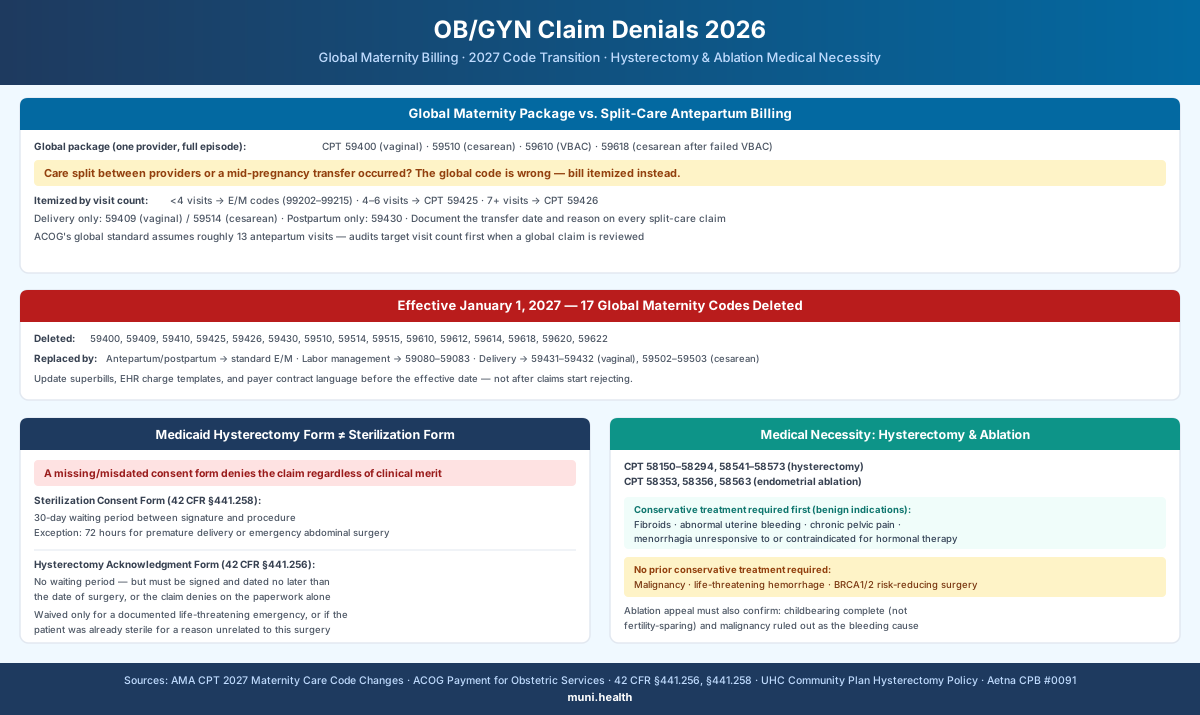
OB/GYN billing splits into two structurally different problems that get treated as one specialty. Obstetric claims are denied for bundling and documentation-transfer errors — the global maternity package assumes one provider delivered all antepartum, delivery, and postpartum care, and that assumption breaks constantly in real practice. Gynecologic surgery claims are denied for a completely different reason: medical necessity documentation and, for Medicaid patients, a federally mandated consent form that has nothing to do with clinical justification.
According to the AMA's 2024 Prior Authorization Survey (n=1,004 physicians), 94% of physicians report that prior authorization delays patient care, and 31% say PA requests are often or always denied. OB/GYN practices carry both the standard PA burden that surgical specialties face and an obstetric-specific bundling problem that most other specialties don't have at all.
Two Denial Families, Two Different Fixes
Treating an obstetric bundling denial and a hysterectomy medical-necessity denial as the same problem is the most common mistake in OB/GYN denial management. A global maternity claim gets rejected because of who provided the care and how many visits happened — not because the care was unnecessary. A hysterectomy claim gets rejected because a specific clinical or consent-form criterion wasn't documented. Sending the wrong evidence to the wrong problem burns an appeal window without fixing anything.
The Most Common OB/GYN Denial Types
| Denial Type | Key CPT/HCPCS Codes | Primary Trigger | Appeal Documentation |
|---|---|---|---|
| Global maternity package mismatch | 59400, 59510, 59610, 59618 | Global code billed when care was split between providers or the patient transferred practices mid-pregnancy | Itemized antepartum code matching actual visit count (59425/59426) plus transfer-of-care note |
| Antepartum visit-count miscoding | 59425, 59426 | Wrong code for visit count, or a global code billed with fewer than the expected visits | Visit log confirming count; use plain E/M codes instead when fewer than 4 antepartum visits occurred |
| Hysterectomy medical necessity | 58150, 58180, 58260-58294, 58541-58554, 58570-58573 | Missing documentation of failed conservative/medical management for benign indications (fibroids, abnormal uterine bleeding, chronic pelvic pain) | Prior treatment trial and outcome; not required for malignancy, life-threatening hemorrhage, or BRCA1/2 risk-reducing surgery |
| Medicaid hysterectomy consent-form denial | Same hysterectomy codes, Medicaid claims | Missing, incomplete, or incorrectly dated Acknowledgment of Receipt of Hysterectomy Information form | Correctly signed and dated acknowledgment form — this is a paperwork defect, not a clinical dispute |
| Endometrial ablation medical necessity | 58353, 58356, 58563 | Missing documentation that menorrhagia was unresponsive to, or contraindicated for, hormonal or medical therapy | Prior therapy trial and outcome; diagnosis code supporting abnormal uterine bleeding |
Global Maternity Package Denials: Global vs. Itemized Billing
The global obstetric codes (CPT 59400 for vaginal delivery, 59510 for cesarean, 59610 for VBAC, 59618 for cesarean after a failed VBAC attempt) bundle antepartum care, delivery, and postpartum care into one payment, built around a standard of roughly 13 routine prenatal visits per the American College of Obstetricians and Gynecologists' obstetric coding guidance. That bundle only holds together when a single provider or practice group delivers the entire episode of care — and a meaningful share of pregnancies don't work that way.
When care splits, the global code is the wrong code. If a patient transfers between providers mid-pregnancy — from a midwife, a family physician, or a maternal-fetal medicine specialist — or if delivery is performed by a different provider than the one who managed the antepartum visits, billing the global package produces an automatic denial or a downcode. ACOG's guidance is specific about the visit-count thresholds that determine which itemized code applies:
| Antepartum Visit Count | Correct Code | Notes |
|---|---|---|
| Fewer than 4 visits | Standard E/M codes (99202–99215) | Not billed as a package code at all — each visit stands alone |
| 4–6 visits | CPT 59425 | Antepartum care only, no delivery or postpartum by this provider |
| 7 or more visits | CPT 59426 | Antepartum care only, no delivery or postpartum by this provider |
| Delivery only (any provider who didn't manage antepartum care) | 59409 (vaginal) or 59514 (cesarean) | Bill separately from the antepartum-only claim |
| Postpartum care only | 59430 | Separate procedure code, billed by the provider who performed postpartum visits if different from delivery |
Document the Handoff, Not Just the Visit Count
A downcoded or denied global maternity claim is usually missing one thing: an explicit note that care transferred, when, and why. Payers auditing antepartum visit counts are looking for confirmation of exactly how many visits this provider performed before deciding whether the global code, 59425, or 59426 applies. A claim that simply bills the global code with no transfer note, when the chart shows a shorter visit history, reads as an error rather than a documented handoff.
What a global-package denial appeal needs when the claim was downcoded or denied over a split-care question:
[Practice Letterhead]
[Date]

[Payer] Appeals Department
[Address from denial letter]

RE: Appeal — Global Maternity Package Denial / Downcode
Patient: [Name] | DOB: [Date] | Member ID: [ID]
Claim #: [Claim Number] | DOS: [Date of Service/Delivery]
CPT Code Billed: [59400/59510/59610/59618, or 59425/59426 if resubmitting itemized]
Denial Reason: [Global package denied / downcoded to itemized antepartum]

Dear [Payer] Claims Review Team,

This claim is being appealed to confirm the correct billing structure for a
pregnancy episode involving [a transfer of care from another provider /
delivery performed by a covering provider / a patient transfer mid-pregnancy].

CARE TIMELINE:
Antepartum visits performed by this practice: [Number]
Prior provider (if applicable): [Name/practice, dates of care]
Delivery performed by: [Name] on [Date]
Postpartum care performed by: [Name]

BILLING BASIS:
☐ This practice performed [4-6 / 7+] antepartum visits only — billing
   CPT [59425/59426], not the global package
☐ This practice performed the full antepartum, delivery, and postpartum
   episode and the global code [59400/59510/59610/59618] is correct
☐ Delivery only was performed by this practice — billing CPT
   [59409/59514] separately from the antepartum claim

SUPPORTING DOCUMENTATION:
- Visit log confirming antepartum visit count with this practice
- Transfer-of-care note or referral documenting the handoff date and reason
- Delivery/operative note

I am available to discuss this case or provide additional documentation.

Respectfully,

[Provider Name, Credentials]
NPI: [Number]
Skip the blank template. Start with a review-ready draft.
Use the template as guidance, or let Muni prepare a payer-specific draft for your team to verify, sign, and submit.
Coming January 1, 2027: The Global OB Codes Are Deleted
This is worth planning for now, not in December 2026. The AMA CPT Editorial Panel has approved a full restructuring of maternity care coding, effective January 1, 2027, that eliminates the global package model described above entirely.
17 Codes Deleted, 12 New Codes Created
Per the AMA, the current global maternity codes — including 59400, 59409, 59410, 59425, 59426, 59430, 59510, 59514, 59515, 59610, 59612, 59614, 59618, 59620, and 59622 — are deleted effective January 1, 2027. In their place: antepartum and postpartum care report through standard E/M codes, new labor management codes (59080–59083) cover initial and subsequent labor days at straightforward or complex intensity, and new delivery-only codes (59431–59432 vaginal, 59502–59503 cesarean) replace the old bundled delivery codes. Same-day routine postpartum care is included in the delivery codes; later postpartum visits use standard E/M.
The change exists because the bundled model no longer matches how obstetric care is actually delivered — team-based care, more frequent provider transfers, telehealth antepartum visits, and home monitoring don't fit a single bundled fee built around an assumption of one provider seeing the patient roughly 13 times. Practices should start updating superbills, EHR charge templates, and payer contract language well before the January 1, 2027 effective date rather than discovering the deletion when claims start rejecting.
Hysterectomy Denials: Medical Necessity vs. the Medicaid Consent-Form Trap
Hysterectomy denials split into two categories that require completely different fixes, and confusing them wastes an appeal.
Medical necessity documentation is the more familiar category. Payer medical policy — for example, UnitedHealthcare Community Plan's hysterectomy medical policy (effective February 1, 2026) — requires documented failure of conservative or medical management before approving hysterectomy for benign indications such as fibroids, abnormal uterine bleeding, or chronic pelvic pain. That requirement does not apply across the board: malignancy, life-threatening hemorrhage, and risk-reducing surgery for a documented BRCA1/BRCA2 mutation are typically considered medically necessary without a prior conservative-treatment trial.
The consent-form category is a separate, non-clinical requirement that trips up practices who assume a strong clinical case is sufficient. Under federal Medicaid regulation, 42 CFR § 441.256, federal financial participation is not available for a Medicaid hysterectomy claim unless the state Medicaid agency has on file a signed, dated Acknowledgment of Receipt of Hysterectomy Information — or a physician's certification in the narrow circumstances where that acknowledgment can be waived (a documented life-threatening emergency, or the patient was already sterile before the procedure for a reason other than the hysterectomy itself). This requirement applies regardless of how strong the medical necessity case is — a missing or incorrectly executed form denies the claim even when the clinical documentation is complete.
Do Not Confuse the Hysterectomy Form With the Sterilization Consent Form
These are two different federal forms with two different rules, and using the wrong one — or applying the wrong timing rule — is a common, entirely avoidable denial:
- Sterilization Consent Form (tubal ligation and similar procedures) requires a 30-day waiting period between the patient's signature and the procedure, under 42 CFR § 441.258 — with narrow exceptions down to 72 hours for premature delivery or emergency abdominal surgery.
- Hysterectomy Acknowledgment form has no 30-day waiting period, but it must still be signed and dated no later than the date of surgery — a form dated after the procedure, left partially blank, or missing a signature is grounds for denial regardless of clinical merit.
Each state Medicaid agency issues its own version of the hysterectomy acknowledgment form under its own form number — confirm the current state-specific form before submission rather than assuming a form used for a different payer or state applies.
Endometrial Ablation Denials: Documenting Failed Conservative Management
Endometrial ablation (CPT 58353 thermal ablation without hysteroscopic guidance, 58356 with cryoablation, 58563 hysteroscopic ablation) follows the same conservative-management-first logic as benign-indication hysterectomy, and most payers require prior authorization before the procedure.
Turn this denial into a review-ready draft.
Muni prepares a payer-specific appeal, policy citations, and an evidence checklist. Your team reviews and submits it.
Per Aetna's Clinical Policy Bulletin #0091 on endometrial ablation, the procedure is considered medically necessary for menorrhagia that is unresponsive to — or carries a documented contraindication to — hormonal or medical therapy. The appeal-relevant documentation gap is almost always the same: the chart lists "heavy menstrual bleeding" without recording what was tried first, for how long, and why it didn't work or couldn't be attempted.
What strengthens an endometrial ablation appeal:
- The specific hormonal or medical therapy attempted (or the specific contraindication, if therapy wasn't attempted) and the documented outcome
- The diagnosis code supporting abnormal uterine bleeding (e.g., excessive/frequent menstruation with regular or irregular cycle, or excessive bleeding in the premenopausal period)
- Confirmation the patient has completed childbearing or does not desire future fertility, since ablation is not a fertility-sparing procedure
- Documentation ruling out suspected malignancy as the cause of the bleeding, since that would change the indicated procedure entirely
How Muni Appeals Helps OB/GYN Billing Teams
Most OB/GYN denials aren't a dispute about whether care was necessary — they're a mismatch between how the claim was coded and what the payer's rules expect for that specific scenario: a split-care antepartum claim billed as global, a hysterectomy missing its consent form, or an ablation denial missing the prior-therapy trial that the payer's own policy asks for.
Muni Appeals organizes uploaded denial materials by these payer-specific criteria, so staff can confirm the visit count, consent-form status, or conservative-treatment documentation actually on file before resubmitting. For the broader prior authorization landscape these denials sit inside, see the complete prior authorization denial guide; for building the clinical justification itself, see the medical necessity justification letter guide.
Practices evaluating whether to handle this volume manually or automate the appeal workflow should also see the appeal automation cost comparison before committing to either approach.
Frequently Asked Questions
When should I bill the global maternity code versus itemized antepartum codes?
Bill the global package (CPT 59400 vaginal, 59510 cesarean) only when a single provider or practice group performed the entire antepartum, delivery, and postpartum episode. If a different provider performed part of the antepartum care — including a mid-pregnancy transfer — bill itemized: CPT 59425 for 4–6 antepartum visits, CPT 59426 for 7 or more, or standard E/M codes for fewer than 4 visits. Delivery-only and postpartum-only care bill separately (59409/59514 and 59430).
Why was my global maternity claim downcoded instead of paid in full?
The most common cause is a visit-count mismatch the payer identified during audit — the chart shows fewer antepartum visits with your practice than the global code assumes, usually because of a care transfer that wasn't clearly documented. Resubmit with a transfer-of-care note stating the handoff date and reason, and confirm the itemized code matches your actual visit count.
What CPT codes are being deleted for maternity care in 2027, and what replaces them?
Effective January 1, 2027, the AMA is deleting 17 global maternity codes, including 59400, 59410, 59425, 59426, 59430, 59510, 59514, 59610, and 59618. Antepartum and postpartum care will report through standard E/M codes, labor management gets four new codes (59080–59083), and delivery-only care gets new codes (59431–59432 vaginal, 59502–59503 cesarean). Start updating charge templates and payer contracts before the effective date.
Why was my hysterectomy claim denied even though the medical necessity documentation was strong?
Confirm whether the patient is a Medicaid beneficiary. If so, the denial may be a missing or improperly executed Acknowledgment of Receipt of Hysterectomy Information form under 42 CFR § 441.256 — a federal paperwork requirement that is separate from medical necessity and denies the claim on its own regardless of how well-documented the clinical case is. Confirm the form is signed and dated no later than the date of surgery before assuming the denial is a clinical dispute.
Is the Medicaid hysterectomy form the same as the sterilization consent form?
No. The sterilization consent form (for tubal ligation and similar procedures) requires a 30-day waiting period between signature and procedure under 42 CFR § 441.258, with narrow exceptions to 72 hours. The hysterectomy acknowledgment form has no waiting period but must be signed and dated no later than the date of surgery. Using the wrong form, or applying the sterilization form's waiting-period rule to a hysterectomy, is a common and avoidable denial cause.
What documentation does an endometrial ablation appeal need if it was denied for medical necessity?
Document the specific hormonal or medical therapy attempted for the abnormal uterine bleeding, its duration, and its outcome — or the specific contraindication if therapy wasn't attempted. Include the diagnosis code supporting abnormal uterine bleeding, confirmation the patient has completed childbearing (ablation is not fertility-sparing), and documentation that malignancy was ruled out as the cause of bleeding.
Does a hysterectomy for cancer or a BRCA mutation still need conservative-treatment documentation?
Generally no. Payer medical policy typically requires documented failure of conservative management only for benign indications — fibroids, abnormal uterine bleeding, chronic pelvic pain. Malignancy, life-threatening hemorrhage, and risk-reducing surgery for a documented BRCA1/BRCA2 mutation are typically considered medically necessary without a prior conservative-treatment trial. Medicaid claims still need the consent-form documentation covered above regardless of indication.
Ready to Stop Losing Time to OB/GYN Billing Denials?
OB/GYN denials are recoverable once the appeal matches the actual defect — a split-care visit count, a missing consent form, or an undocumented conservative-treatment trial. Resubmitting the same claim without fixing the underlying mismatch just restarts the clock, and the global maternity codes most practices have billed for years are being deleted in under six months.
Muni Appeals helps OB/GYN billing teams:
- Organize appeals by denial type instead of treating obstetric and gynecologic surgery denials the same way
- Match documentation requirements to the specific payer policy and claim type
- Surface consent-form and visit-count requirements for staff to verify before resubmission
This guide reflects 2026 OB/GYN billing and appeal procedures, including the CPT maternity care code changes effective January 1, 2027. CPT code requirements, payer prior authorization rules, and Medicaid consent-form regulations are updated regularly and vary by state and plan. This information is for administrative and billing purposes and is not medical advice.