

This calculator estimates your practice's potential savings from automating insurance appeals, combining your monthly revenue, appeal volume and staff hourly rate with the fixed example assumptions below. For context: a 2023 national survey of 280 hospitals found the average cost to fight one denied claim was $57.23 in staff labor (Premier Inc., published Feb 2025). Muni Appeals costs $20 per appeal, with the first 3 free.
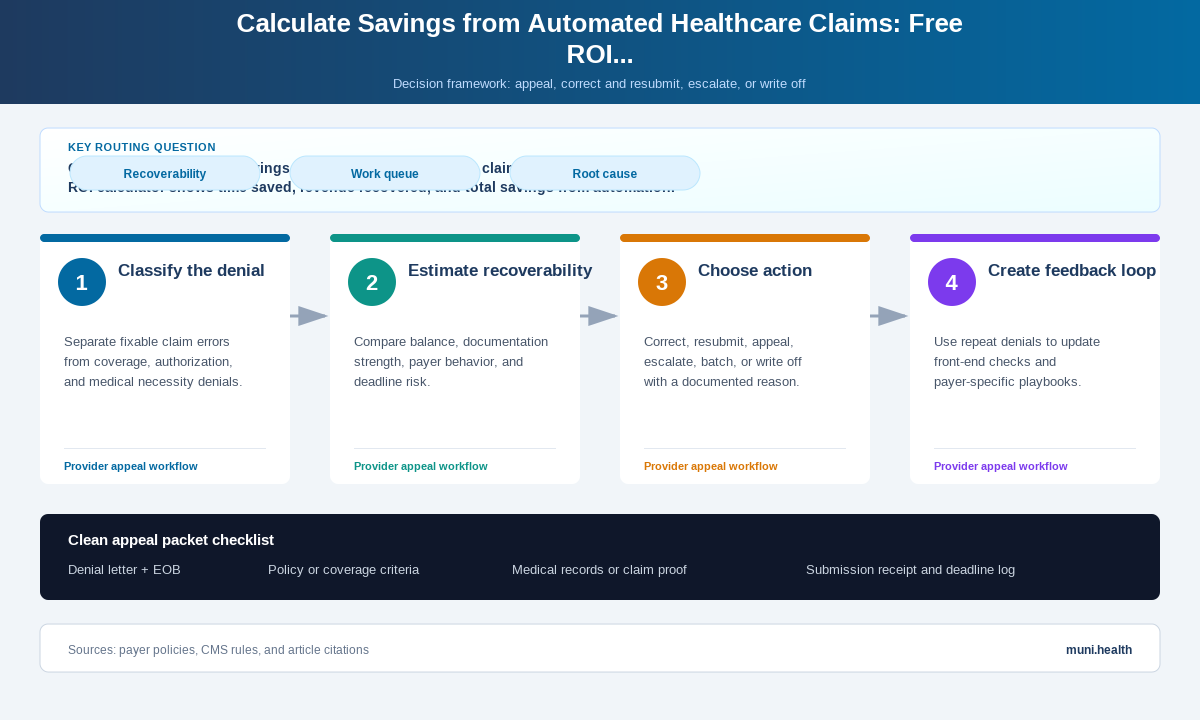
Calculate Your Potential Savings from Automated Healthcare Claims
Calculate Your Savings with Muni Appeals
See how much time and money your practice could save by automating insurance appeals.
*Calculations use modeled assumptions: a commonly cited industry-average appeal success rate (~67%) improving to a benchmark for complete, well-documented appeals (~80%), manual appeal time of 45 minutes vs 5 modeled minutes with Muni, and $20 per appeal (first 3 free). These are estimates, not measured Muni statistics — actual results vary by practice.
Why Calculate Your Healthcare Claims Automation ROI?
Claims adjudication — including the cost of fighting denials — cost U.S. hospitals and health systems an estimated $25.7 billion in 2023, according to a national survey of 280 hospitals and health systems conducted by Premier Inc. Because roughly 70% of denials are ultimately overturned and paid, the survey estimated that nearly $18 billion of that spend went toward claims that should have been paid the first time (Premier Inc., published Feb 24, 2025). That's hospital-system data, not an independent-practice-specific figure, but the underlying dynamic — most of the cost is staff labor, not the claim itself — holds at any practice size.
Most practices don't realize how much of that cost is happening in their own billing office because they:
- don't track staff time spent per appeal
- don't compare their actual denial rate against what they're recovering
- have never compared manual labor cost against a per-appeal automation price, or against what an outsourced billing service's percentage-of-collections fee would run for the same work — see Outsourced Billing Service vs. Appeal Automation for that comparison
What Actually Drives the Cost
The same Premier survey found the average cost to fight a denied claim rose from $43.84 in 2022 to $57.23 in 2023 — a 30% increase in one year — and that labor accounted for 90% of that cost, not software, postage, or filing fees.
Key Statistic
The average cost to fight one denied claim rose 30% year-over-year, from $43.84 (2022) to $57.23 (2023), in a national survey of 280 hospitals and health systems. Source: Premier Inc., published Feb 24, 2025.
Prior authorization work adds to that burden before an appeal is ever filed: the AMA's 2024 Prior Authorization Physician Survey (n=1,000 physicians) found PA consumes an average of 13 hours of physician and staff time per week (AMA, published Dec 2024). Appeals compete for that same staff time.
How the Calculator Estimates Your Savings
The calculator above has three adjustable inputs: your monthly revenue, appeals filed per month, and your billing staff's hourly rate. This page uses the following fixed example assumptions:
- Denial rate: 22%, used with monthly revenue and appeal volume to estimate average appeal value.
- Time per appeal: 45 minutes manually and 5 minutes with Muni, a modeled difference of 40 minutes per appeal.
- Appeal success: a modeled increase from 67% to 80%, used to estimate additional recovery.
The calculator does not offer controls for these assumptions. They are examples, not measured Muni outcomes or verified benchmarks for your practice. Actual time and recovery depend on your workflow, denial type, documentation and payer.
Muni's cost is not modeled — it's the actual published price: $20 per appeal, first 3 free, no subscription (muni.health/pricing).
Both "Additional Recovery" and "Time Saved" are modeled estimates. The annual Muni cost applies the published per-appeal price and free-credit allowance to your entered volume; it does not establish that the modeled savings will occur.
See what a $20 appeal actually includes
Muni drafts the letter, cites the payer's policy, and builds the evidence checklist — you review and submit.
Try Muni Appeals FreeFirst 3 appeals free, then $20 per appeal. Start with your denial letter or EOB and available records. No meeting or clearinghouse connection required.
What Actually Drives Appeal Success
Appeal outcomes vary far more by denial type and documentation completeness than any single "success rate" number captures. In KFF's analysis of 2024 ACA marketplace data, insurers upheld their original denial in about two-thirds of internal appeals filed by consumers — meaning roughly a third succeeded — and fewer than 1% of denied in-network claims were ever appealed in the first place (KFF, 2024 data). That figure covers all appealed claims, not just well-documented medical necessity appeals specifically, so it isn't directly comparable to a provider-side, fully-documented appeal.
Prior authorization appeals tell a different story when the denial is procedural rather than clinical: KFF's analysis of CMS data found insurers fully or partially overturned 83.2% of Medicare Advantage prior authorization appeals in 2022 (AMA, citing KFF/CMS data) — evidence that a properly filed, well-documented appeal often succeeds even where the initial denial rate is high.
The practical takeaway: which denials are worth appealing, and how likely they are to succeed, depends on denial type and documentation — not a single blended percentage. See When to Appeal an Insurance Denial: Decision Framework for the full triage breakdown by denial type.
Muni Appeals doesn't publish a blended success-rate percentage, since outcomes depend on documentation quality, denial type, and payer — the same factors that make a single industry-wide number unreliable in the first place.
Time Not Spent on Appeals
Every hour not spent researching and drafting a denial appeal is an hour available for patient care coordination, insurance verification, or denial-prevention work upstream. The calculator's "Time Saved" figure models that possibility using the fixed 45-minute manual and 5-minute Muni assumptions; compare those with your actual workflow.
What's Included in Muni Appeals Pricing
First 3 appeals free, then $20 per appeal. No subscription.
- Drafted appeal letter with payer-policy citations
- Evidence checklist and recommended next step
- Credits never expire
- No credit card required to start
- No setup fees, no contracts
- BAA signed with every customer; data encrypted in transit and at rest
Details current as of publish date — verify current pricing at muni.health/pricing.
Frequently Asked Questions
How accurate is the ROI calculator?
You can change monthly revenue, appeals per month and staff hourly rate. The example fixes the denial rate at 22%, manual time at 45 minutes, Muni time at 5 minutes, and modeled success at 67% versus 80%. There are no controls to override those assumptions. Time savings and additional recovery are estimates, not observed performance or guaranteed results; compare the assumptions with your own records before using the output for a decision.
What if my practice has fewer than 8 appeals per month?
Muni's pricing has no minimum — you pay $20 per appeal with no subscription, so low volume doesn't carry fixed overhead the way a monthly tool would. The first 3 appeals are free regardless of your monthly volume, so you can see the actual product before deciding whether the per-appeal cost makes sense at your volume.
Does this include prior authorization denials?
Yes, Muni handles prior authorization appeals as well as claim denials. PA appeals are often worth prioritizing because they're time-sensitive — the patient is typically waiting on treatment — and because well-documented PA appeals tend to succeed at a high rate: KFF's analysis of CMS data found insurers overturned 83.2% of Medicare Advantage PA appeals in 2022 (AMA, citing KFF/CMS data).
Can I try Muni before committing?
Yes. Your first 3 appeal credits are free with no credit card required. Run your actual denials through the product and see the results before paying anything.
Ready to Estimate Your Potential Savings?
Enter your monthly revenue, appeal volume and staff hourly rate to see an estimate using the fixed example assumptions above, then compare it against Muni's published price and your own records.
Start with 3 free appeal credits:
- No credit card required
- Full product access
- 3 appeals free, then $20 per appeal, no subscription
Industry figures in this post are cited and linked to their original sources (Premier Inc., AMA, KFF) with the year the underlying data reflects. The ROI calculator combines three user inputs with the fixed example assumptions described above. Its time-savings and revenue-recovery estimates are not measured Muni statistics or guaranteed outcomes. Muni pricing reflects the published price at muni.health/pricing as of the date above and is subject to change.